Author Archives: margueritequantaine

Unknown's avatar

About margueritequantaine

Marguerite Quantaine has been a writer-designer-essayist for 60+ years. As the Historical Research Editor of Consumers Power Magazine she was first published in 1964, spent 10 years as a corporate executive in NYC's advertising and garment industries, and another 50 years as a columnist-editor of New York and Florida publications. A freelance essayist for The St. Petersburg Times (2000-2009), she penned her first novel, IMOGENE'S ELOISE, at age 67 and is currently working on ELOISE'S IMOGENE, the second book in this planned trilogy. SERIOUSLY, MOM, you didn't know?,was released in May 2019. Active in the rescue of animals since feeding her first feral cat in 1949, she and her happily engaged partner of 56+ years have been adopted by 21 dogs and 51 cats along the way.

PAST, IMPERFECT, INTENSE

Me@7

My father taught me things. They weren’t always the right things, or the best things, but he taught me all things, well.

One winterkill night while driving home alone together, he taught me his truth about lying. I was 7, then.

My mom was working as a confidante and caregiver at a private cottage for forlorn cancer patients. Her curtailed quietus watch of 11 to 7 promised us six kids we wouldn’t awaken without her.

“I’ll always be here to tuck you in and be back before breakfast,” she assured. It was enough for them, but not for me.

“I’m riding along,” I reckoned.

“Maybe in the morning, if you’re up.”

“Then, too,” I determined, set as cement.

She gently pressed the nub of my nose, lighting me up in her eyes. “You’re my little lion,” she said. “You give me courage.”

My parents weren’t friends then, if ever. Lovers once, no doubt. He as dashing as she was beauteous. Each with ebony locks. His, glossed waves. Hers, coiled curls. His jaw, chiseled. Her cheeks, rubicund. His eyes, bruin black, set tangent to an arrowed nose. Hers, bairn blue, gracing a Gaelic bob. Both seeped sheen and sensuality. The two as one? An envied ornament hung among plebeians.

But that was all ephemeral, lost long before the happenstance of me.

Oh sure, photos find him masterful in monochrome. Meritorious. Certainly indubitable. And it can be quibbled he didn’t become deriding and distant until after he began colorizing her with kids.

Regardless, I never espied demonstrative signs of affection between them. Neither gentility, nor joy. She endured his disrespect as wifeliness, while zesting motherhood. He husbanded acrimoniously, fatherly only to his firstborn.

And so it was, of all the trips we made together with mom in tow or mind, I remember that worst one best.

“DammitallMaggie,” he one-worded her. “It’s nearly 11. Move it!”

“Don’t get your dander up,” she growled back while winking my way. The dishes, nearly done. The laundry, almost folded. The house in chaos but cleaned down the middle and after-a-fashion. My siblings accounted for, kissed and sleeping. “I’m ready when you are.”

It was the most they’d spoken to one another all day, remaining silent in their seats until he skidded to the stop where we left her – just in time.

I remember watching her maneuver the hard packed snow and patches of ice while edging her way up the embankment toward that halfway house of enduring desperation. And how my father peeled off, leaving her without help, headlights, or sentiment for her safety.

During the drive home I kept my face glued toward the passenger window, contented to imagine mom in the morning, and it being my nose pressed against the frosted pane, greeting her return to us.

My father spoke to the back of my head when he said, “People lie to you because they don’t respect you enough to tell the truth.”

I remained removed; brown eyes searching boundless skies.

“They’ll cloak their words in omission, feigning innocence, thinking you’re too stupid to recognize the lie.” He paused, letting it etch.

I counted stars.

“That’s what they’re saying though. That they think you’re stupid.”

I yearned for Jupiter and Mars.

“The more deliberate and petty the lie, the less value they make of you.”

I found Venus.

“You know you’re utterly worthless when someone lies to you for sport.” He reiterated and enunciated, “Utterly.”

…and more
THE ABOVE EXCERPT IS FROM:

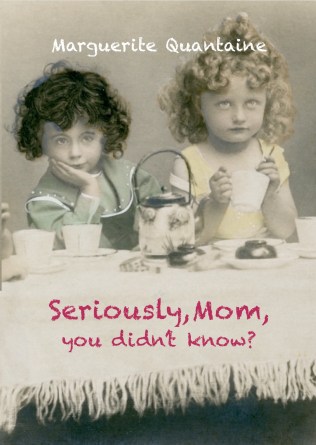
Seriously, Mom, you didn’t know?
by Marguerite Quantaine © Copyright 2019

THIS LINK OPENS TO A FREE 3+ CHAPTER PREVIEW
(If it skips ahead, just tap the left arrow.)


# # #

This freshly edited, updated essay by Marguerite Quantaine first appeared in the St. Petersburg Times five years ago. (Copyright by Quantaine © 2008 • 2013)

IMPERFECT CHILDHOOD? Lessons learned? Please select REPLY to share your thoughts.

I’m all eyes and heart.

A CAUSE FOR CELEBRATION

B1

The preliminary police report rendered me dead upon impact.

A drunk driving a Marathon cab fitted with an extended, reinforced steel bumper had broadsided us. He was clocking up to 70 in a 30-mph zone when he ran a red light and collided with the VW Bug I was easing into a parking spot as Liz sat next to me in the suicide seat.

The impact was ferocious. While peripheral vision allowed me a glimpse of my killer, there was no other warning. No screeching of brakes. No screaming of pedestrians. No sense of impending doom. Just a mild feeling of astonishment before whispering, “Oh my God, I’m dead.” That’s what I said.

Our car was ripped apart (lengthwise) from hood to trunk, welding the sheared pieces to the front end of the taxi. Twenty feet away, our flung wreckage had come to a halt at the entrance of a branch bank. I hung down twisted and broken through the remains, my face hovering just above the pavement, my auburn curls resembling a red rag mop.

Most gay couples are drawn and quartered by such tragedy. They’re impeded by laws awarding jurisdiction to distant family members. They’re intimidated by protocol and prodded by propriety. Their feelings and wishes are summarily dismissed as irrelevant. Barred from the ambulance. Excluded from intensive care. Denied decision-making.

“She’s my sister,” Liz lied emphatically. It instantly ended any question of her authority.

The first time she lied was to the officers who barricaded the wreckage, then tried to restrain her from reaching back for me. They’d dragged her clear, insisting I was beyond help.

How she broke loose, and what transpired is a wonder.

I must have responded to the energy of her touch. I must have been warmed to the blending of her tears in my stone-cold eyes. I must have sensed the silent incantations of her heart imploring mine to hold the course of ‘us’ as one, against all obstacles and odds.

“Hey, babe!” I breathed.

Her second lie was to the ambulance attendants. The third, to emergency room doctors. The fourth, to nurses. And then to technicians, aides, and investigators. She didn’t hesitate to claim me as her sister, knowing involuntary deceit had long been coerced from gays in lieu of being banished and public humiliation.

Lies were once our only conceivable lifeline.

Fortunately, I was a corporate executive for a large conglomerate. It gave me special insurance privileges that provided her with unlimited hospital access. She stayed in my room. She partook in every detail of my care and was privy to all my medical information. My doctors consulted her. My nurses kept her updated.

Nevertheless, when it came to certain courses of action, not everything suggested was automatically allowed.

It’s because (even now) most lesbians mistrust the medical profession. We cringe at the prospect of contact with male doctors. We shy to probes pertaining to our personal lives and intimate behavior. And, even though many older women entered conventional relationships in an effort to hide their true sexual identities, there are vast numbers of lesbians who have never engaged in intimacy with a man. Women who know being gay goes far beyond an aversion to heterosexual sex; that the differences in our genetic codes include a wiring that circuits a deep-seated aversion and basic incompatibility with all dominant aspects of the opposite gender.

It’s as if (equivalent to the distinction found between Asian and African elephants trumpeting in the night) science will someday discover that we, too, are a similar — but different — species.

So it came as no surprise to Liz when I refused to be catheterized, even though catheterization was necessary to save me. Regardless of the brutal total body trauma I suffered, this perfectly natural anomaly had triggered my sense of dignity, demanding decorum. Only the empathy and courage of a surgical nurse named Christine could clear the emergency room of male doctors and provide me with the symbiosis I needed to survive.

…and more
THE ABOVE EXCERPT IS FROM:
Seriously, Mom, you didn’t know?
by Marguerite Quantaine © Copyright 2019

THIS LINK OPENS TO A FREE 3+ CHAPTER PREVIEW
(If it skips ahead, just tap the left arrow.)


#   #   #   #

This freshly updated essay by Marguerite Quantaine first appeared in the third person in The St. Petersburg Times (2008) and Venus Magazine in the first person (2010).  Copyright by M. Quantaine © 2008 / 2010 / 2013.

Please share your thoughts here by selecting REPLY.

I’m all eyes and heart.

AS GOOD AS GAY GETS

One determined little 5 year old.

One determined little 5 year old.

By Marguerite Quantaine

Someday my novel will be optioned by a mainstream publisher, rate stellar reviews, be adapted to film oozing romance through eloquent innuendo, and receive the acclaim of people who’ll prattle over my sudden success.

But they’ll be instantaneously mistaken (about my success being sudden) because I’ve worked hard all of my (remembered) life.

I began my callings at age 5, collecting castoff bottles for return to wooden crates at the corner, single pump gas station with its big red cooler of cola immersed in ice water and a grease monkey teetering on a beat-up stool next to it paying me a penny a find.

At 7 (being small and scrawny for my age), my brother dressed me as a waif to knock on the doors of upper class condos, selling occupants Christmas cards they probably never sent, but gave me my dollar a box because I looked so pitifully poor, like a melancholic mutt on the street corner wagging its tail, twanging their untuned heartstrings.

At 8, I shoveled snow with a spade in the winter (that’s right, a spade), pushed mowers in the summer, and raked leaves in the fall, underpaid with nickels by anyone willing to exploit me.

At 10, I delivered newspapers on my brothers routes, rising before daybreak to cut the hairy nylon twine from big bundles left on neighborhood street corners, rolling and folding each paper to perfection, burnishing and stuffing them into a canvas bag dragged along behind me, pitching the papers towards porches, then hurrying home in time to don a dress and walk 3 miles to school (that’s right, 3 miles).

At 14, I claimed I was 15 to get a genuine job (4 to 9 weekdays, 9 to 9 on Saturday) selling records at a store that only hired boys for the 30 years before I sailed through the door.

“Why should I hire you?” asked the owner, a doddering, Dickens-like character whose bifocals were as thick as block glass and modish flattop belied his desire to appear younger. “Boys bring in girls who like records.”

“Boys flirt with girls that giggle and irk paying customers,” I countered. “Boys arrive late, leave early, take cigarette breaks, and call in sick from phone booths at football games.” I let that set a second before adding, “I have red hair. I’m cute enough to attract boys who’ll talk to me about girls. I’ll sell them records for those girls. Whenever they win one over — and they will (I winked) with my expert advice — they’ll be back to buy more.”

“Expert advice?”

“I have a two-sport-varsity older brother and one bombshell of a sister. I’ve heard all their gameplay. Try me. You’ll see.”

He did, teaching me purchasing, cataloging, product display, inventory control, advertising, and promotion. I was the first girl hired there, then the first girl hired as a research editor for a local trade magazine, then the first girl hired as a proof-runner for the daily newspaper before I finally fled my hometown for the big city beat.

I arrived in New York with $126.00 lining my red-rubber boots, no job prospects, no place to live, and no plans beyond attending The American Academy of Dramatic Arts where I’d earned an entry after winning the regional finals of a television talent search in which I’d been entered (unknowingly).

Being awed and alone in Manhattan was thrilling. I saw all directions as arrows angled upwards.

All I had going for me was attitude on my first day (faking-it) as a graphic artist.

All I had going for me was attitude on my first day (faking-it) as a graphic artist.

Insisting “Oh sure, I can do that” gained me the gig of being the first female hired as a graphic artist at the United Parcel Service (even though I’d never seen a t-square, held a razor knife, or knew how to crop a photograph). After several months of (intense) covert tutelage by the fellow at an adjacent art board, I snagged a (enviable) job at a Fifth Avenue ad agency where I was promoted to management (the first female Purchasing Agent) in 5 months time. Within 3 years I parlayed that into a corporate office fashion industry position where I excelled until being struck by a drunk-driven taxicab. The driver flew the coop and the cab company declared bankruptcy (as did the insurance company holding the cab’s policy), catapulting my career back to ground zero (accompanied by chronic disabilities).

and more
THE ABOVE EXCERPT IS FROM:

Seriously, Mom, you didn’t know?
by Marguerite Quantaine © Copyright 2019

THIS LINK OPENS TO A FREE 3+ CHAPTER PREVIEW
(If it skips ahead, just tap the left arrow.)

# # #

Is (gay) life good for you? Are you (still) dreaming (big)?
Select REPLY and tell me.

I’m all eyes (and heart).

Miss Edna’s Heartifacts

New Edna Window

I never danced on a grave, but did steal something from the dead, once. I spied it, pried it loose, flattened it against the belly beneath my blouse and walked away without contrition.

It happened one sultry late-summer day when ocher leaves are as omnipresent as the sun a half-hour before high noon. I felt myself liquefying in line while waiting my turn to take a number.

“Who was she?” I asked the fidgeter in front of me.

“Nobody,” he said.

“Everyone is somebody,” I suggested.

“Name was Miss Edna,” drawled the clerk recording the details off my driver’s license. “You be biddin’ on the house?”

“I’m sorry?”

“Cuz it hasta be moved. Otherwise, it’ll be bulldozed in two weeks time. Land ain’t fer sale. Yer number seventy-six. Next?”

The house was one of those classic Cracker shacks built on a farm axed out of a forest that encroachment slaughters and sacrifices to almighty developers. Where highways supplant front yards claimed by eminent domain.

Miss Edna’s epitomized such woe, its slats of ill-fitted wood slapdashed together and embalmed in asbestos shingles that the sun blistered into coarse curls. Rust stained the ridged metal roof, inside and out. You could peer through her windows and peek through her walls.

“Did you know Miss Edna?” came a voice.

I turned to see a wisp of a girl, all blond and bowlegged in mismatched plaids and stripes, with dangling plastic beads being balanced on broken fingernails.

“No, I didn’t. Did you?”

“Of her, mostly,” she conceded, evading my eyes as she spoke in halting speech as broken as her spirit. “Mom died birthing her. Dad made her pay for it ‘til he croaked.”

“Never married?” I asked.

She sighed. “Eloped on horseback to the forest. Honeymooned, camped down by the Silver River. But the old man hunted them with dogs. Beat the boy bloody. Strapped his broken body to a horse and jest whipped it on away.”

“Dead?”

…and more
THE ABOVE EXCERPT IS FROM:
Seriously, Mom, you didn’t know?
by Marguerite Quantaine © Copyright 2019

THIS LINK OPENS TO A FREE 3+ CHAPTER PREVIEW
(If it skips ahead, just tap the left arrow.)


# # #
JWept longshot

This freshly edited, updated essay by Marguerite Quantaine first appeared in the St. Petersburg Times three years ago.  (Copyright by Quantaine © 2010/2013)

Please share your thoughts, here, by selecting Reply.

I’m all eyes and heart.

THE LOOK OF LOVE

Front Cover 4 FBI’m a ninth generation American homosexual.

Either that or there’s an amazing number of spinsters and bachelors in my ancestry. I count the potential for several in every generation on both sides of the family over the past 350 years.

Perhaps that’s why the stigma attached to being single wasn’t an issue in my upbringing. My father’s sister never married. And even though the topic of why wasn’t openly broached, my maternal grandmother divorced after her second daughter was born. She spent the balance of her life as single, in the close company of women.

I suppose you could misconstrue this as proof that it’s possible to be raised gay, or that I was. But you’d be wrong. I wasn’t raised to be sexual at all. Like so many of my generation, the subject of sex was taboo in our home. And even though I grew up with two sisters and three brothers, we never shared conversations of an intimate nature until we were all well into our forties. Even then, the conversations between us were strictly casual.

My father was as distant by choice as my mother was demonstrative by nature. It was she who showed us how happiness flows from doing good. We learned to be courteous, courageous, curious and kind. We were exposed to music, literature, art and theater. We were trained to respect language through oratory and debate. And while exploring the works of William Shakespeare, my mother implored us to hold dear the line, “To thine own self be true.”


So don’t think it took some long struggle with my sexual identity before I spoke the words “I’m gay” to my mom. Nor was it her fear of hurting my feelings that kept an exchange from happening before she reached 89.

It’s simply — believe it or not — most lesbians I’ve encountered don’t consciously categorize themselves as being such, per se. I know I don’t. I never have.

True, I avoided dating while in high school and remained chaste until halfway through my 23rd year. By then the family phone fêtes had my younger sister convinced I was a recluse while my older sister swore I must be on something (or should be).

Hence, when I called home from New York City that glorious March day in 1970 to tell Mom I’d be bringing a friend back for a visit, she was delighted. She didn’t question what the relationship entailed or which gender it involved. All that mattered was I’d finally connected with someone.

No one has questioned it since. Elizabeth remains the only love of my life. For the past 49 years, we’ve lived under the same roof sharing the same bank account, abiding by the same ethics, collaborating in the same businesses, supporting the same candidates, and demonstrating the same respect and affections for an array of animals.


We’ve never been purposely apart in all those years. Never taken separate vacations, or wanted to. Never appeared at gatherings alone. Never accepted an invitation unless the other’s name was included on the envelope. Never sent a birthday card, letter, or holiday greeting without our joint salutation.

We aren’t provocative or particularly political. There’s no role-playing, recognition-dressing, or exhibitionism. And, even though our choice to remain reserved is based on a nothing-to-hide-nothing-to-share ideology, you can’t exactly classify us as closeted.

The fact is, a rare few have ever asked us, “Are you gay?” Instead, we’ve been treated like any other two people who graciously appear as an extension of the other. But then, at age 89, Mom finally brought it up.

“Why now?” I asked her during our daily long-distance chat.

“I watched a biography on television last night about two men who had this great devotion for each other,” she recounted. “And I marveled at how wonderful it must be to know that kind of love. It made me think of you and Liz.”

My eyes welled.

“But they led such tragic lives in many ways,” she continued. “I hope no one’s ever been mean to you like that.”

I recognized a question masked in those words.

•••

Mom and I were always close. She was a role model for the independent spirit I became, a mentor of uncommon good sense, and a show of courage in the face of futility. But there are things I’d never confided — mostly because they all occurred to me in retrospect, long after I’d missed the meaning of the stone thrown.

I recall I’d just turned 15, fresh from being voted the wittiest girl in my class and slated to become editor of the school paper, a forensics champion, pantomimist, and finally, most photographed face in my senior yearbook. Plus, some considered me cute to boot.

Yet I was never a team player. I rarely attended school events. I avoided pep rallies. I didn’t spend after-hours with classmates. I resisted temptation and defied intimidation, refusing to follow the crowd. And I simply didn’t date.

It’s not that I lacked opportunity. Indeed, my primary pals were male. But I was careful to keep boys at bay, preferring platonic relationships restricted to school hours or clustered occasions. Because my mind wasn’t functioning in the immediate present back then. It was clouded with illusions of running off to New York’s West Village to live as a Bohemian poetess and consumer underachiever.

One afternoon while stopping to pick up books for history class, I noticed a word scrawled sideways down my hallway locker, with letters the six-foot length and one-foot width of the door: Q-U-E-E-R.

———– TO CONTINUE READING ————
THE ABOVE ESSAY REPRESENTS AN EXCERPT FROM:
Seriously, Mom, you didn’t Know?
by Marguerite Quantaine © Copyright © 2019

You can finish this story by clicking this link to open the book to Chapter One for a FREE read of it, plus 2 more chapters:


#    #    #

Marguerite Quantaine is an essayist, novelist, and animal rights activist.

This refreshed essay copyrighted by Marguerite Quantaine © 2002 first appeared in The St. Petersburg Times and will serve as the introduction essay in her latest book,

Seriously, Mom, you didn’t know? by Marguerite Quantaine

NOW ON AMAZON & AVAILABLE IN BOOKSTORES NATIONWIDE

Available in paperback and on Kindle, May 13, 2019.

Tagalong

Every year at this time I use a luminescent-ink marker to highlight the kitchen calendar in memory of a miniature, copper-tinged Pekingese that was thrust into the arms of my partner one gusting, sleety night by a battered woman we barely knew who hastened backward, shrieking that her husband had beaten her and now vowed to kill her dog.

Liz buttoned the trembling puppy inside her coat to ward off quitclaim and cold, later presenting him to me as having “followed” her home.

“Uh-huh. He just tagged along after you,” I supposed before learning the dire details.

“How utterly desperate that woman was,” Liz sighed.

“Dear little earth-angel,” I whispered and kissed as tears welled up in my eyes. “From now on, you’ll be our Tagalong.”

We shared a fast affinity, Tag and I. Liz could feed, bathe and walk him – but most of his time was spent moored to me.

Besides being irresistible, three particulars made Tag precious. First, he’d been born on Liz’s birthday, ensuring endearment. Second, he adored me. Enough said. Third, he could talk.

Yes. Talk. And, I could understand him. Perfectly.

Whatever he said came into my head. And whatever entered my head came out of my mouth as what he wanted known, done, or felt. A kind of oratory by osmosis.

The talk was just between the two of us at first, but eventually we let Liz in on it. Then my mom. Then my sisters, and so forth. As word spread, we gained a following, albeit essentially esoteric. Family, friends and neighbors were ever eager to hear Tag talk. Most were mesmerized. A few were dubious. But only skeptics dismissed us as a slick trick.

Initially, even Liz vacillated, since I never struggled to decipher the dog’s din. The warble of his words would emerge clear from my mouth, almost simultaneously.

Then one wee hour of a mid-March morning as the wind whipped at the windows and thunder menaced, Tag began to whine, chant, and drone, mouth waggling, head bobbing, paws pawing.

“What’s happening?” Liz growled, preferring coziness of covers to dealing with predawn disasters.

“He says the upstairs porch is leaking. Rain’s coming in through the sunroom ceiling.”

“Dogwash, ” she spat, adamant.

But Tag persisted.

So, Liz donned a robe and snarled her way down the stairs, words burning blue behind her. Defiantly, she flung open the French doors to the sunroom where – sure enough – water showered the floor.

“Now!” she conceded as we mopped up the mess, “I’m a believer.”

...and more
THE ABOVE EXCERPT IS FROM:
Seriously, Mom, you didn’t know?
by Marguerite Quantaine © Copyright 2019

THIS LINK OPENS TO A FREE 3+ CHAPTER PREVIEW
(If it skips ahead, just tap the left arrow.)

Find Me On Amazon • Friend Me On Facebook •  Follow Me On Twitter

#   #   #

This freshly updated essay by Marguerite Quantaine first appeared in The St. Petersburg Times, fifteen years ago.  (Copyright by M. Quantaine © 2002/2013/2017)

Pet memory? Please, share it here.

I’m all heart and eyes.

Heartstrings 101

Deatsville wasn’t any bigger than a whistle on a walk in 1954, and about as far due south of my Michigan birthplace as any eight year old could imagine. The roads running east and west past Popeye’s two pump, glass globe gasoline stop and shop had the soft, dust-rusty look of a boiled bare five-and-dime enamelware pan.

I’d traveled to Deatsville to spend the summer with my cohort, Molly, and her parents who owned that screen door gathering spot frequented mostly by natives of Elmore County and daytrippers from Lomax and Verbena who’d gotten sidetracked on their way to Montgomery.

Molly and I were counterfeit cousins, joined at the heart and mind’s-eye instead of the kinsman hip. Our mommas had been best friends before us. They’d met in New York City where each had fled during the 1930’s, intent on finding a more sophisticated lifestyle than that of a small town girl grown into a small town wife. Marriage and children returned them to convention, but our births had awarded each a vicarious second chance at adventure.

In time we’d give them their dreams, but for that last unadulterated summer of our youth we were as any other children growing up in the kind of rural community that red line roads on paper pocket maps connected.

“Do as you’re told and make me proud,” was always my mother’s marching order. I did and would.

I arrived by bus, the driver making a stop at Popeye’s even though it wasn’t on his scheduled route. Had he chosen to obey orders to pass Deatsville by, visitors and residents of the area would have had to find additional transportation back to there. Stopping was the common southern courtesy that northern dispatchers were forced to either ignore or accept.

Molly and her dog, Buford, greeted me by dancing barefoot in the dirt, a piece of her momma’s pecan pie held high in her right hand while she wigwagged the left.

“Hi you all, “ she enunciated with an exaggerated drawl.

I kissed her. Then I bent down and kissed Buford before attacking the pie.

“I ate mine already but you can share yours with me if you want,” she hinted.

We slept in a tall-walled room at the end of a tongue and groove hallway in a 19th century carpetbaggers house set five hundred feet back from the store. It was a proud, old, chipped-paint clapboard structure with faded green plantation shutters hiding nine foot, nine-over-nine pane windows, most of them swollen shut. Those that worked opened like doors onto wraparound porches connecting pencil post pillars to a sloping tin roof that provided both shade and shelter from the relentless heat and sudden white rains of an Alabama afternoon.

“I’ve got a secret to show you,” Molly whispered to me one afternoon while we were pretending to nap. Together we crawled under her grandma’s iron bed and removed the floorboards to an inwardly opening trap door exposing a ladder that took us ten feet down into a somber cellar of red clay and hollowed out slots where candles once burned as lighting.

———– TO CONTINUE READING ————
THE ABOVE ESSAY REPRESENTS AN EXCERPT FROM:
Seriously, Mom, you didn’t Know?
by Marguerite Quantaine © Copyright © 2019
NOW ON AMAZON & AVAILABLE IN BOOKSTORES NATIONWIDE
You are urged to LOOK INSIDE on Amazon for a try-before-you-buy FREE READ of the first 3 chapters. Click FREE PREVIEW BELOW THIS COVER.


#  #  #

Lie To Me

Kids aren’t stupid. They know we’re being deceptive about bullying. They see how pervasive it is. They feel offended by the pretense and abandoned by the denial, especially those who endure the ridicule of a relative using words as weapons. I know I did.

Fortunately, my mom taught me to prevail by helping me deflect criticism with an equanimity that best prepared me for the external world.

Still, like all kids, I felt an instinctive need to protect my mom – so she never knew my kindergarten teacher was a bully.

I’d been enrolled at Helmer school, a brown brick building in the public education system that flew a coveted green Safety flag above the Stars and Stripes, raised together each morning to wave as symbols of pride over the tar-top playground.

The Safety flag sported a white silhouette of a stick-figure child. It was presented to the school holding the student record for the longest accident-free period in the district. Helmer flew the flag for thirteen consecutive years before I began kindergarten in 1951. But since I’d been hit by a car while chasing an irresistible red ball five weeks earlier, the flag went to its cross-town rival, Cascades Elementary.

As retribution for my misfortune I was shamed daily by my teacher, Miss Beech, who announced my folly on the first day of class, separating me from the circles of instruction, insisting I move my rest period rug to a solitary area, making me take my milk and cookies break alone, and relegating me to a chair in the corner during art activities, thereby branding me as a bad apple.

“I wish you died,” one classmate whispered to me daily during recess. Eventually she stopped and probably forgot. But I never have.

Except for my time at Helmer, I remember all my grade school teachers fondly – primarily because by third grade our family moved across town to the school district where I automatically became the kid responsible for Cascades being awarded the Safety flag.

That still makes me smile.

But by then I’d already learned that self-confidence and resiliency was the best defense against bullies.

So when my Girl Scout troop leader fostered intimidation by flagrantly favoring girls whose parents were members of the Country Club, I resigned and sent a letter of complaint to the Council. It wasn’t acknowledged or acted upon, but the mere writing of it served to strengthen my backbone and cement my resolve.

It wasn’t until junior high that cliques began forming based on beauty between girls and sports between boys. While holding daily court in the cafeteria at lunchtime, some of them entertained by taunting outcasts within earshot.

One gym teacher enjoying camaraderie with parents of the miscreants showed her allegiance by embarrassing students targeted by the cliques. In addition to assigning them extra laps, she openly scorned their abilities and detained them for fabricated infractions. The first day she aimed her mockery at me I left class and never returned.

Years later, on the afternoon I was to graduate as the student with the most scholastic medals pinned to her robe, my class counselor called me in for a conference.

“Your records indicate you failed gym for six years running,” he said.

“I didn’t fail. I didn’t go.”

“Then you can’t graduate until you do.”

———– TO CONTINUE READING ————

THE ABOVE ESSAY REPRESENTS AN EXCERPT FROM:

Seriously, Mom, you didn’t Know?
by Marguerite Quantaine © Copyright © 2019

You are urged to try-before-you-buy FREE READ of the first 3 chapters.
Click FREE PREVIEW BELOW THIS COVER.
(If it skips ahead, just tap the left arrow.)

Find Me On Amazon • Friend Me On Facebook •  Follow Me On Twitter

# # # #

Copyright Marguerite Quantaine © 2013

THE THIRD TIME I DIED

I generally avoid talking about this. Dying, that is. I’ve coped with its aftermath, living on borrowed time for more than forty years now. But of the actual deathblow, followed by the leaving here and being elsewhere? No.

True, I wrote it down soon after, copious information, complete with diagrams and a glossary of terms totally foreign to me. And, yes, I told someone. Naturally, it was met with skepticism, having occurred two decades before disclosures of near-death experiences became common.

The thing is, my death-death doesn’t exactly duplicate what others have echoed to the awe and applause of audiences.

So, let me go back far enough for long enough to tell you just enough and nothing more.

The first time I died was several days after I was born with pneumonia in 1946, when the incidence of it was still the leading cause of infant mortality in America. According to my grandmother, I was discharged from the hospital to die “again” at home after doctors declared, “There’s nothing more we can do for her.”

Some would contend it was my grandmother’s and my mom’s hourly rotating attention that saved me. But grandma insisted otherwise.

“It was an onion,” she assured with a Swedish intonation, her hair braided and pinned to her head like a peasants crown from the old country she refused to speak of and claimed not to know. “On your chest.”

I never really understood the significance of that pungent bulb’s role until recently when I read that an onion begins to absorb the viruses and bacteria in a room the moment it’s cut. I’m now convinced that if I place a raw onion on the nightstand next to my bed at the first inkling of a cold I’ll sleep more soundly and awaken well, or (at very least) breathing better. Regardless, I’ve ceased saving the remains of sliced onions for future use.

The second time I died I was six weeks shy of my fifth birthday. While playing with my dog (an Irish Setter named Clancy) in the front yard of our home, I chased a ball out into the street where I was struck by an oncoming car. (A taxicab, to be exact.)

I vividly recall running, the dog, the ball, the sandstone ledge I scooted off, the cement sidewalk with it’s chalk drawn hopscotch squares, the sunbeams filtering through the still leaves of oak and chestnut trees, my innocence on that August afternoon, the dense, prismatic glass of headlights, a shiny chrome grill, and feeling mystified just before being hit.

I do not recall my death, or anything happening directly afterward.

But I can still see – just as clear can be – me standing near the porcelain countered sink in our century old kitchen, becoming oddly aware of myself with my mom behind me, gently running a wide-tooth comb through my hair and tying it with ribbons. My hair was long. The comb was pink. The ribbons were yellow.

“May I have a class of water?” I muttered.

“Did you say something, Dolly?” she answered, as if in disbelief.

“Water.”

I’d not been taken to a hospital. I’d simply been snatched up from where I landed (fifteen feet further down the street), carried into the house, and laid out.

———– TO CONTINUE READING ————

THE ABOVE ESSAY REPRESENTS AN EXCERPT FROM:

Seriously, Mom, you didn’t Know?
by Marguerite Quantaine © Copyright © 2019

You are urged to try-before-you-buy FREE READ of the first 3 chapters.
Click FREE PREVIEW BELOW THIS COVER.
(If it skips ahead, just tap the left arrow.)

Find Me On Amazon • Friend Me On Facebook •  Follow Me On Twitter

# # #

The Fine Art of Name Calling

When I was in college my roommate, Gloria Tata, called me Magpie. I didn’t understand why at the time, having only associated the word with that of a large, black, squawking bird.

At 5’1” and 90 pounds, fair skinned and red-haired, I didn’t see myself as a crow anymore than I saw her as a Po-Tata, a nickname that sprang to mind but was never uttered because I instantly censored it as knee-jerk, uninspired, and possibly used as a tag to taunt during her school yard years.

Instead I simply changed the inflection and called her Ta-Ta, as if saying “so long” or “goodbye” whenever greeting her.

I first met Gloria one afternoon at the Wayne State University Student Union in Detroit after buying the last piece of pie, cherry, my least favorite, just before a cafeteria worker put out plates of blueberry, my pie of choice. The place was so packed it took a while to find a seat, and when two were finally vacated, Gloria plopped down beside me, each of us spying a preferred pastry on the others tray.

“Trade?” we said, simultaneously. It initiated both our friendship and a series of subsequent exchanges. We liked each other’s winter coats better, so we traded. We like each other’s watches better, so we traded. We even traded boots, bangles, and binoculars – mine being more compact to her large lug-arounds.

At the end of the semester I was ordered to find other lodgings as retribution for missing my 10 o’clock curfew at the dormitory one night and awakening the dorm mother by howling like a desolate dog. It was just as well. I felt suffocated living on a hallway of freshwomen who joined ranks to form instant cliques concentrated on rushing various sororities.

Fortunately, a two room plus bath unit opened up on the third floor of the only independent apartment building left standing on campus that I happened by at the exact moment the superintendent placed a For Rent sign in the lobby window. Knowing I couldn’t afford the place alone, I signed on the dotted line, certain of Gloria’s willingness to join me. She did.

Gloria looked remarkably like Marisa Tomei (who wasn’t born until December of that year so, technically, Tomei would come to look remarkably like Gloria). She was a straightforward, high-spirited girl whose only college aspiration was to find a man to marry – which she did within a matter of months. Never mind that he was a much older, slovenly, heavyset biker. To Gloria he complemented her newly acquired black leather jacket, ankle tattoo, Chantilly perfume and Chiclet gum-smacking act.

———– TO CONTINUE READING ————
THE ABOVE ESSAY REPRESENTS AN EXCERPT FROM:
Seriously, Mom, you didn’t Know?
by Marguerite Quantaine © Copyright © 2019
NOW ON AMAZON & AVAILABLE IN BOOKSTORES NATIONWIDE
You are urged to LOOK INSIDE on Amazon for a try-before-you-buy FREE READ of the first 3 chapters.

Find Me On Amazon • Friend Me On Facebook •  Follow Me On Twitter

https://www.amazon.com/Seriously-Mom-you-didnt-know-ebook/dp/B07R95DP4V/ref=sr_1_fkmrnull_1?keywords=Marguerite+quantaine&qid=1557274594&s=gateway&sr=8-1-fkmrnull
Yep.

That would be me – à la modus operandi.

# # #