
Cathy was obsessed with death. As the last born into our family of six children, the one topic she’d invariably ask me on hers, and each of our siblings birthdays was, ”Who do you think will go first?”
My answer remained immutable. “Go where?”
“You know,” she’d persist. “Die.”
I never thought and never guessed, letting her speculate year in and out, mostly by phone from a distance, but the last sixteen years in person.
The first time she asked and answered was while putting together a Scrap Book she received for her birthday in 1957.
“It’ll be David.” She was matter-of-fact about it.
“Why?”
“Because I’m 9 today and he’s 9 years older, so as the start he’s closer to finishing.”
“You think you’ll watch us all go?”
“I haven’t figured that out yet,” she admitted, busily writing 1954 or 1955 under every photograph being pasted in the album.
“The house photo was from when we left there in 1953, and you weren’t even four years old in those other ones,” I corrected. “They should say 1951 and 1952.”
“I know. My book is about the before we aren’t ever again.”
She was referencing how my father had sold our home on the newly wrong side of town in favor of a house none of us wanted but him. So, she was right from the get-go. We weren’t.
The most cherished gift Cathy ever gave me was her Scrap Book.
In the center of the first page she had cellophane-taped a caption from a 1950’s local newspaper photograph:
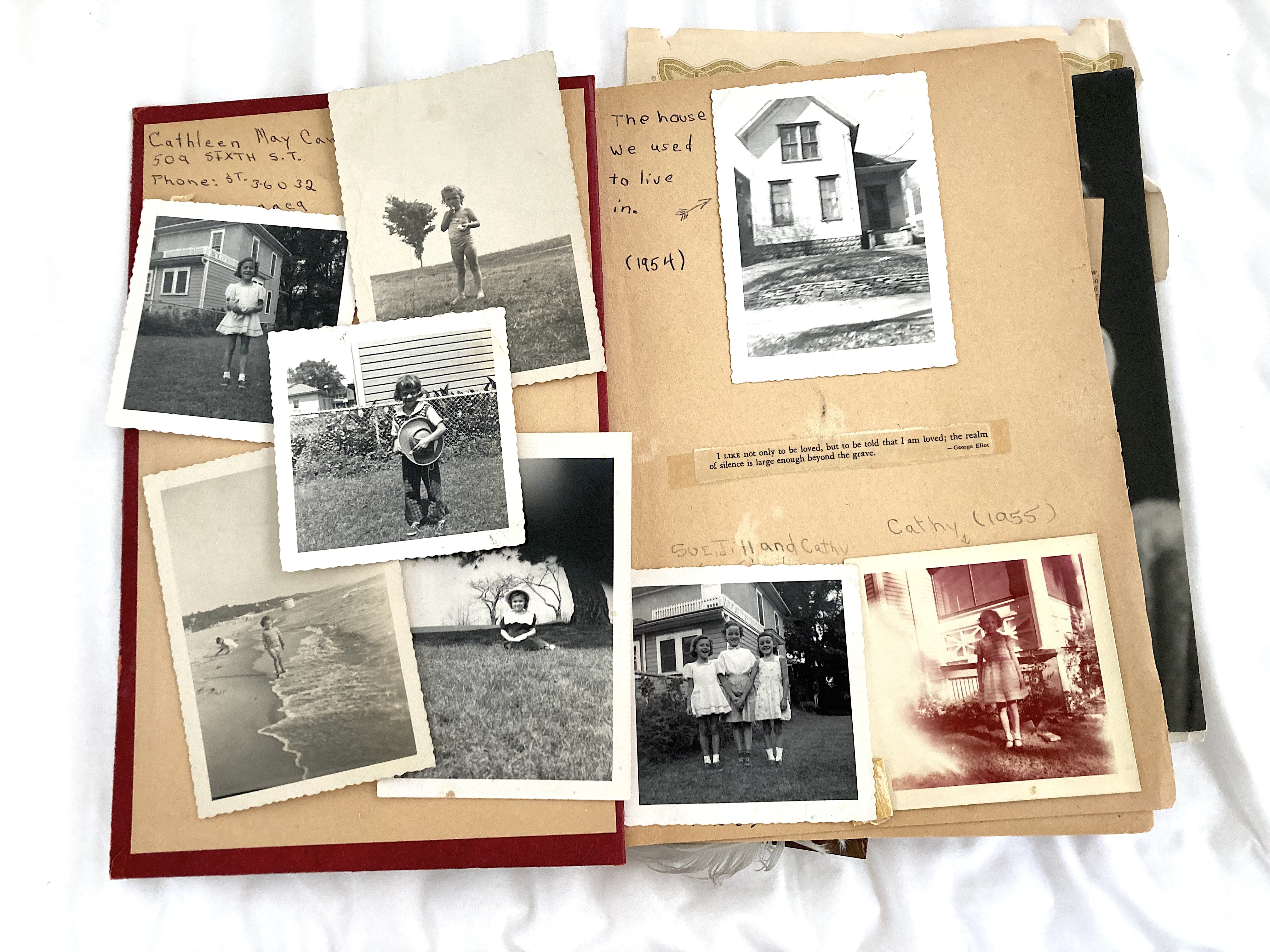
“I like not only to be loved, but to be told that I am loved: the realm of silence is large enough beyond the grave.” — George Eliot
Almost as if she always knew.
Cathy left us in 2016.
The first of six.
#. #. #.
Marguerite Quantaine is an essayist and author.
“There’s never been a colored, a Jew, a Democrat, a Yankee, a queer, or a woman as Mayor of this town and there never will be!”
I glanced up from my notes to study the odd little man in his Oshkosh overalls, Penny’s plaid shirt, knee-high Frye boots and Tom Mix hat.
His cohorts called him Red. I don’t know if he was christened that, or nicknamed for the color of his neck — but it certainly didn’t stem from embarrassment by him, or any of the men at that district Republican Committee meeting rewarding him with whistles and a rousing applause as I sat alone in the far back corner of the small auditorium, recording the forum as a favor to the absent president of our local Republican Women’s Club.
And, all I could think was — what luck!
I wasn’t a committee member, so I couldn’t object without risking the security of self. But I was born in the small town that hosted the first Republican convention, under the oaks on July 6, 1854. An obscure granite rock with a bruised bronze plague once sat on a tiny patch of treeless grass, three short blocks from where I spent my most mis-informative years.
Back then, the rites of passage included adopting both the religion and political party affiliation of your parents. My parents were protestant and Republican. I’m neither, but during my juvenescence, I feigned being both.
The reality is, religion and politics have never been roadblocks for me. I tend to accept that we’re all going to believe what we need to believe in order to survive our slippery slope slide from here into hereafter. However, the pretense of politics alarms me, and it is the reason I always encourage women to run for public office.
I have.
It’s easier than you think, and more satisfying than you dare to imagine.
After filling out the simple forms with the Americanized spelling of my last name and paying a nominal filing fee, I learned you aren’t required to raise money, put up signs, hand out cards, take out ads, stand on street corners in inclement weather inhaling exhaust while waving to commuters — or even to serve if elected. All of which I did not do.
Instead, I entered the citywide race for Mayor because I could. And, because I learned the Mayor was in charge of the police force that allegedly created computer software profiling every resident according to age, gender, race, religion, political affiliation, marital status and coded lifestyle.
I ran because the Mayor had the power to veto city council legislation.
I ran because the personal voting records of all residents, their addresses, and phone numbers can be made available to campaign camps via their candidate.
I ran because it’s possible for local elected officials to access sensitive census information about their neighbors.
Ultimately, I ran to be be given equal time to speak at all candidate gatherings, lunches, forums, debates, and media interviews, followed by unlimited time to answer questions. Places where I could tell the people about the profiling, veto capability, records reality, and potential for both discrimination and profiteering to the detriment of the electorate should the information be misused by unscrupulous officials with a personal agenda to advance.
But chiefly, I ran because I was told by Party heads, “You cannot.”
“And yet,” I said, “I can.”
“You can’t run as a Republican.”
“Unless I’m registered as a Republican. Then I can.”
“It’s a nonpartisan race, so no one will know.”
“Unless it’s leaked.”
“You won’t have the backing of the Republican Party.”
Aye, and there’s the sub rosa.
Most of us like to think we’re supporting a candidate who shares our convictions and has our best interests in mind.
Go.
Run for office.
That’s when you learn it’s the Republican National Committee (RNC), the Democratic National Committee (DNC), and corporations funding them that dictates the conversation, feeds the media, and virtually runs this country in a Charlie-McCarthy-meets-Jerry-Mahoney-manner, where those connected contingents funnel all the money solicited from donors into the war chests of the candidates they’ve preselected to win.
I kid you not.
The nominees of both the RNC and DNC sign a Party platform pledge to toe the Party line, in order to receive the financial clout of the RNC, or DNC, because the chances of winning an election for those who don’t sign — even on a local level — are zip, zero, nada, nil.
And, get this: Those war chests can be used to funnel funds for phone banks to robocall citizens who have a voting history of going to the polls on odd, even, and off years. • They can funnel funds for surveys with contrived questions for the ostensible purpose of suggesting nonexistent improprieties practiced by the opposing party. • They can funnel funds for spamming newspapers with testimonial templates to praise one candidate, or deride the other, or push an agenda, or create confusion, or imply majority support, with each letter signed and sent by a party faithful — so it appears to the public as an original thought and legitimate concern rather than a parroted message. • They can funnel funds for business owners to be visited by party members offering recommendations on which candidates to support, along with a friendly suggestion of how valuable it is to have a customer base of political party members. • They can funnel funds for whisper campaigns, leaked to small presses, controlled by deep pocket party-pleasers, linked to online sites willing to post the disinformation.
And, get this: The strategies for beating your opponent are all recorded (or were when I ran) in an instruction manual detailing how to sway an election to a preferred candidate with news stories clouded by opinion. Where the media inserts the words ‘could, might, alleged, contend, claim, may, and if’ for ‘can, is, are, and will’ to report a ‘possible’ truth. Where newspaper corrections to falsehoods are buried in places no one reads. Where editorials aren’t required to be factual.
The old, paraphrased maxim still holds true: The most dangerous woman in the world is the one who can’t be bought.
That’s where running for political office serves as the American dream. Because running to lose by telling the unmitigated truth assures that your voice will be heard.
And isn’t that what we all want? To be heard?
When I ran for office, my words were so well heard, by the time election day rolled around they’d been stolen and used to further the campaigns of others running for even higher offices.
So, ladies, that’s how you make change happen. Not by sitting behind a safe screen, typing out rhetoric about what’s wrong with the country and who’s to blame. And, not by writing a check, convinced your donation will contribute to making this nation better and stronger.
Run for office.
Attend every avenue available for you to get up and speak. Recognize freedom of speech for the priceless gift it is. Say what’s in your heart. Ignore naysayers. Concentrate on connecting with real people. And experience the exhilaration that comes from putting your mouth where your mind is.
In the final analysis, the financial reports required to be filed by all candidates indicated the incumbent spent around one hundred and twenty-five dollars per ballot cast in favor of him to wage his campaign against me, while I didn’t spend a dime.
On election night I lost by less than 100 votes.
No, not once.
Twice.
Because the next time around I ran for school board, losing by lesser votes.
Whew!
#. # #.
Seriously, Mom, you didn’t know? By Marguerite Quantaine • Copyright © 2018
MY SISTER KATE BELIEVED IN THE TRUTH. She thought she recognized it, practiced it, and that it would always prevail.

But I’m not sure truth ever was or can be. Nor am I certain of its prevalence in society today since all alleged truth stems from whatever was written beforeus, as if verified as absolute fact.
And given that even the most inspired of wordsmiths are writers-at-soul, we each must choose from multiple abstracts of speech, edicts, merged thoughts, external influence, doubt in some entities, unbalanced confidence in others, and a necessity for meticulous punctuation in order to advance beliefs — all while knowing the end result will be subjected to individual interpretation using multiple mediums regardless of the author’s intent.
Enter the innate willingness for many to automatically believe whatever is being told them and — worse yet — parroting those narratives as if each utterance was an original thought from which errors can be justified by citing a misdi- rected faith in the charisma of charlatans dressed in fleece.
Please don’t get me wrong by taking me out of context.
I harbor no objection to faith. It’s an effective, convenient, efficient, popular, time-honored tradition that’s both easier to embrace than most of us are willing to admit and necessary for the survival of both the fittest and unfit.
What I question is an inclination to believe the worst in others, as if in doing so we’ll esteem ourselves to those whose alliance we crave.
What I find dubious is our rallying to deny rights to those unwilling to join school cliques, group cliques, office cliques, organization cliques, political cliques, and awards cliques.
What I cannot fathom is the instant exclusion of those we’ve never met nor ever spoken to based solely on what’s been heard from a friend, relative, or associate about a stranger.
Think of how many times you’ve united against bullying in our schools over the past decade, assailing the abusiveness of name-callers as detriments to society.
And yet, sixty million Americans voted for a name-caller to lead this nation and participated in the notion of locking up a person who has never been indicted, arrested, booked, tried, or convicted of any crime in her lifetime while another hundred million Americans capable of taking action chose to do nothing at all.
In a patriarchal society (which ours is) I can understand how misogyny can flourish among males. But the implausibility of misogyny is such that I cannot understand how it thrives among females!
Except… I do?
Perhaps it’s because every news anchor, commentator, journalist, politician, and figurehead over the years fail to question the ecclesiastical elephant in the room.
I first recognized the enormity of its presence forty-two years ago when I refused to attend my brother Michael’s wedding.
At the time, I’d been in love with my Elizabeth for seven years, a woman who’d not only been crucial to saving my life after a catastrophic car crash, but had eagerly, earnestly, and single-handedly tended to my long-term recovery for five of those seven years. Nevertheless, the invitation to my brother’s nuptials didn’t list Elizabeth’s name, nor did it include her as a plus-one option.
As a result, I declined the invitation.
Now before you feel any indignation on my behalf, please, don’t. Remember, it was 1977. Homosexuality had only recently been declassified as a mental disease, while me and mine remained labeled by law as felons at risk of being sentenced as such. We were outlaws, social misfits, deviants, and — worse yet — a cause for embarrassment.
Even now, there are communities in America where being homosexual is portrayed as justification to detain, although not prosecutable; municipalities where dissident gender profiling can divert police from responding to assaults, or delay ambulances from arriving in a timely manner; where medical treatment is subpar and getting away with causing a death as a result could go unnoticed or be ignored altogether. (It’s at this you should take umbrage.)
My brother’s wedding was viewed as a big deal because, of six children (all of us then in our 30s), only two were married. It was likely his union would mark the last chance for my mom to be a mother-of-the-intended ever again. So, even though it was discreetly discussed and agreed that my Elizabeth should have been invited, I was nonetheless demonized for my decision not to go — right up until the portion of the actual ceremony where the bride agreed to obeyher husband. It caused my sisters and mother to storm through our front door several hours later echoing each other.
“Thank God you weren’t at the wedding, thank you, thank you, thank you, thank you, oh my God, thank you for not coming! You would have caused an uproar. Even we nearly did!”
It’s true. They knew me well. I’ve never taken kindly to being submissive to, or even particularly respectful of, male authority. At very least, any sacred pledge to obey would have made me gasp conspicuously, if not trigger an audible spontaneous, “No-o-o!”
Which returns us to those questions unwritten by journalists, unspoken by news anchors and commentators, unsought by pollsters, unaccounted for in election booths, unstatesman-like in Congress, unaddressed by constituencies, unadulterated, unanticipated, unalterable, unapologetic, unassuaged, unappeasable, unsettlingly, unstudied, and (perhaps) unassailable, untouchable, untenable, and even unrighteous in the final analysis.
But not unaskable.
Does a woman’s pledge to obey her husband require being dutiful to his choice of candidates when she is casting her ballot? And if so, does that mean America has become a Silent Theocracy?
###
This is an excerpt from
Seriously, Mom, you didn’t know?
by Marguerite Quantaine ©2019
First published as an essay © 2016 @margueritequantaine.com
Marguerite Quantaine is an essayist and novelist who values your opinion and appreciates you for sharing this with others.
Please select LEAVE A REPLY by clicking below the Hush. Hush Sweet Charlatan headline.
•
BOOKS BY MARGUERITE QUANTAINE ON KINDLE & IN PAPERBACK CAN BE FOUND ON AMAZON & AVAILABLE IN BOOKSTORES NATIONWIDE. You are urged to LOOK INSIDE for a try-before-you-buy for a FREE READ of the first 3 chapters on Amazon.
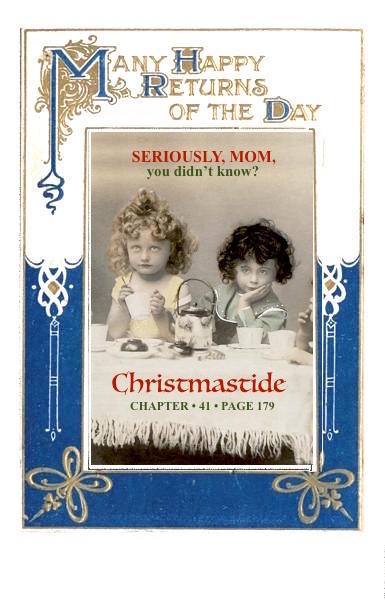
Cleone’s favorite song was Joy To The World directed by the Philharmonic Orchestra and sung by the Mormon Tabernacle Choir. She’d begin playing it as a daybreak reveille on December 12th and continued through the morning of her birthday, December 27th. We were reminded of the fifteen-day musical salute while driving Elizabeth’s mother back to Arkansas in November 1990.
.
“How come I don’t remember this tradition, Mom?”
.
“You’re never home for the holidays more than a day or two, Elizabeth Ann. Besides, your daddy and I only began it after you left home.”
.
During those long gone thirty years since Elizabeth’s father died, Cleone remarried several times. As a southern lady rooted in Montgomery, Alabama, she was raised to believe a woman’s life wasn’t complete without a man in hand. Her current husband of ten years, Bill, had been confined to a nursing home, diagnosed with violent hysterical dementia. He hadn’t recognized her (or anyone) for six months and never would again, but that didn’t stop Cleone from visiting him daily, ignoring his foul-mouthed curses and dodging food spat in her direction.
.
We promised to stay with her through Thanksgiving, but our plans changed after she asked me to sort through stacks of Bill’s personal papers to determine if any needed keeping.
.
The first item of interest I came across was his association with a local white supremacist group. He kept Nazi propaganda, recruitment paraphernalia, racist hate tapes and a loaded .38 in his desk drawer next to a box of hollow point bullets. I immediately incinerated everything burnable and buried the gun in his asparagus garden.
.
Other discoveries were as serious.
.
“Mom,” I tiptoed, “it says here Bill used your Certificates of Deposit and savings as collateral for the mortgage to purchase this house.”
.
“He promised they’d be safe until the house is paid off.”
.
“You’re 83, and he’s older. The mortgage is for 30 years.”
.
“I guess.”
.
“Who pays the mortgage?”
.
“It’s automatically deducted from my social security check each month.”
.
“You have your own direct deposit checking account?”
.
“Yes. Mine pays the car loan, utilities, and property taxes, too.”
.
“Why isn’t it all deducted from his account?”
.
“He pays the insurance, charge cards, grocery account, and incidentals.”
.
I hesitated just long enough for her to ask, “Why?”
.
“Well, what’s important is I can tell you how to fix what I’ve found, so there’s nothing for you to get upset about. Since you have his health proxy and financial power of attorney — over his very sizable bank accounts, I must say — it’s merely a matter of shuffling funds.”
“Meaning?”
.
“You have the authority to write checks.”
.
By then, both Cleone and Elizabeth were eager for details and had pulled chairs up to the table where I was working. “Mom, your name isn’t on the mortgage, deed to the house, or car title. If Bill should suddenly die, the house and car go directly to his son. His Will leaves his savings and all his belongings to his son. The executor to his estate is his son. His life insurance policy names only his son.”
.
“What about me?” Cleone asked, matter-of-factly.
.
“He made no provisions for you, Mom.”
.
“Do you think his son knows any of this?”
.
“According to these letters, he does.”
.
I let that sink in between mother and daughter while I ran some figures and finalized a plan.
.
After breakfast, the three of us dressed for success in matching hot pink sweatsuits and strings of vintage pearls before descending on the bank where Cleone paid off the mortgage and car loan from Bill’s savings account. Once her CDs were released and there was no longer a lien on her savings, she transferred all automatic deductions for household expenses from her checking account to his. Finally, she removed his name as survivor from her accounts and left the bank, unencumbered.
.
“How do you feel, Mom?” Elizabeth asked.
.
“Free,” she answered.
.
We stayed on until the 9th of December, gadding about town, buying and wrapping Christmas presents, lighting her ceramic tree, delivering cookies, addressing cards, and confirming plans for Cleone to move to Florida to take up residence in our home after the first of the year.
.
“Are you sure you don’t want to drive back with us now,” Elizabeth hoped.
.
“No, dear. I want to spend the holidays here with my Bridge club and church group. It gives me time to say a more leisurely goodbye.”
.
“Are you okay?”
.
“Better than okay, Elizabeth. I’m having fun!”
.
It took us three days to drive home. We arrived on Cleone’s birthday, greeted by a cheerful message on our answering machine from her. I immediately dialed her back, putting the phone on speaker.
.
Cleone’s next door neighbor answered.
.
“Your mom called for an ambulance. The driver swore he got here within a minute. He knew her from church and around town. Everyone loved your mom.”
.
Knew.
.
Loved.
.
We sped back to Arkansas.
. . . . .
After arranging her funeral and hosting a large reception, we had Cleone’s casket returned to Montgomery where we provided her with a second funeral attended by 135 of her friends and remaining relatives. Internment was next to Elizabeth’s father in a small, historic burial ground where all their ancestors also rested. A second reception followed.
.
The next morning, Elizabeth and I returned to the cemetery a final time.
.
It was a serene, unseasonably warm December day with no breeze blowing nor snow on the ground. We marveled at the height and width of tiers of fresh flowers left on Cleone’s grave, in stark contrast to the other mostly ancient tombstones void of any signs of recent visitors, decorated with weather‐worn plastic plants, faded flags, or no mark of remembrance at all.
.
Instinctively, we began removing fresh flowers from her mother’s final resting place to spend the next few hours adorning the surrounding graves, one-by-one, until as many sites as possible in the cemetery had a small bouquet.
.
Then we rolled down all the windows of the car, popped in a cassette, pumped up the volume to maximum, and slowly drove up and down each pathway playing and replaying
Joy to the World.
###
.
.
Marguerite Quantaine is an essayist and novelist.
She values your opinion and appreciates
your sharing of this with others.
.
Please select LEAVE A REPLY by clicking below the headline.
.
CHRISTMASTIDE © by Marguerite Quantaine
An excerpt of Chapter 41, Page 179 from her book
SERIOUSLY, MOM, you didn’ know?
.
NOW ON AMAZON & AVAILABLE IN BOOKSTORES NATIONWIDE
IMOGENE’S ELOISE : Inspired by a true love story by Marguerite Quantaine
SERIOUSLY, MOM, you didn’t know? by Marguerite Quantaine
You are urged to LOOK INSIDE for a try-before-you-buy FREE READ
of the first 3 chapters on Amazon.
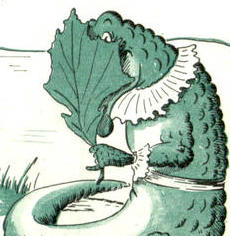
The first time I spotted the alligator in the murky waters of a man-made lake framing luxurious condos on one side and a city park on the other, I worried aloud for the safety of the mallards, Muscovy, and white, waddling ducks, the snapping turtles, giant goldfish, flock of pristine egrets, and wading blue heron, making their homes in the marshes there.
“And, the kids who play in this park,” my sweetheart added.
I didn’t respond. Not that I would ever want a person of any age to be harmed by an alligator, but there was no imminent danger in that. Only the nature-preying-nature lurked.
The lake is more for show and tell by realtors looking to justify pricey units with a view. There’s no swimming allowed, and since it’s illegal to feed wildlife in Florida outside of a reserve, observing nature in this park is mostly done from a deck built 15 feet above, and stretching 20 feet out over the water, where picnic tables are placed for brown baggers wondering what so many thieving sea gulls are doing there, some sixty miles inland.
At first, all I saw were the mammoth marble shaped alligator eyes, trolling the lake’s surface, leaving innocent ripples of water in his wake.
“Or,” she said when I pointed out the marauding eyeballs, “it’s a submarine.”
“No, hon, I’m pretty certain it’s an alligator.”
“But, I’m thinking…”
“It’s a gator, okay?”
“I’m just saying what it could be,” she persists, as the tire-like tracks on it’s back emerges. “Or, maybe one in camouflage to look like an alligator, so no one would suspect.”
Really, who am I to say otherwise? I thought.
We only visit this particular park once a year, in September or October, depending on what date the High Holy Days fall.
I won’t expound on the significance of these 10 days for those of you who aren’t Jewish, but I will share the custom of casting bread upon the water (tashlikh) as a symbol of one’s transgressions being disposed of. Unlike other religions, Jews don’t believe in original sin. Instead, we’re born pure, acquiring our indiscretions with age, intent, or ignorance along the way.
But, if we’re sincere in saying “I’m sorry” to those we’ve wronged, and have done good without expectation in return, and made an earnest effort to mend fences, the sin slate gets wiped clean on Yom Kippur, giving each of us another chance to get life right, and do it better.
…and more
———– TO CONTINUE ————
THE ABOVE ESSAY REPRESENTS AN EXCERPT FROM:
Seriously, Mom, you didn’t Know?
by Marguerite Quantaine © Copyright © 2019
NOW ON AMAZON & AVAILABLE IN BOOKSTORES NATIONWIDE
You are urged to LOOK INSIDE on Amazon for a try-before-you-buy FREE READ of the first 3 chapters.
Find Me On Amazon • Friend Me On Facebook • Follow Me On Twitter
This essay was first published entitled See Ya Later Alligator in 2015 and continues to be revisited each year at this time in memory of those who have passed, and with hopes we all continue to be written into The Book of Life. ~
Marguerite Quantaine is an essayist and author. Copyright, © 2015-2018
# # #
PLEASE SHARE YOUR FEELINGS ABOUT THIS ESSAY by scrolling down and selecting REPLY.
I’m all eyes and heart.
# # #
.
I NEVER LEAVE MY FINGERPRINTS on any surface other than pants and shirts, not necessarily my own. Call it obsessive compulsive disorder (because that’s what it is), expediency is key to me cleaning my hands. If something foreign gets on one, anyone standing near me can expect a spontaneous pat on the back.
~
A compulsion to keep my hands clean has been with me since kindergarten when I refused to finger-paint without a brush. Chaos erupted when all the kids wanted one. It christened ‘fastidious’ as my Star of David to bear (personally and professionally) ever since.
~
As an art and antiques columnist for a string of east coast trade papers during the late 70’s and early 80’s, I was commissioned to do an article on 19th century Commonplace Books. These oversize tomes were maintained by women in lieu of journals, decorated with pressed flowers, calling cards, idioms, autographs, photographs, news clippings, and exquisite chromolithographed die-cuts of animals, birds, bouquets, angels, hands, hearts and holiday images — no doubt the forerunner to modern day scrapbooking.
~
In hopes of gaining a personal perspective, I tried keeping a Commonplace Book, but failed miserably. At the time I claimed it was because I feared damaging the vintage die-cuts I’d collected. But truth be told? Elmer’s Glue-All did me in.
~
After several frustrating attempts, an editor suggested I settle for substituting one daily commonplace occurrence of joy, instead. I never actually completed the assignment, but I am still keeping the book.
~
These are randomly selected happy-dance (commonplace) occurrences.
~
September 22, 1996
It’s Sunday and still pouring sheets of rain, as it was when we went to pick up the papers and I spotted a poor old dog lying hurt in the gutter at the edge of the Methodist church parking lot. It enraged me! The mere thought that, even though the parking lot was packed with worshiper’s cars, there wasn’t an indication anyone had stopped to help that poor dog. I loudly denounced the depraved indifference of people in general (and this group in particular) as I jumped out into the deluge, only to discover the dog was dead and drown to boot. I make no apologies for the blubbering that overcame me as I dialed 911. They promised to send an officer immediately. In the interim, we dashed home (4 blocks) to get a clean, dry burial blanket to wrap the dog in, and returned just as animal control pulled up. After conversing briefly with the officer — a kind and sympathetic man who recognized (even through the blinding rain) how distraught I was. I gave him the blanket before I kneeled down into wastewater and petted the mongrel, apologizing for the cruelty of mankind, and blessing it’s soul and spirit, asking that I might be the best of it. Between sobbing and the downpour I was pretty much waterlogged by then, making it a struggle to get up before motioning to the officer that it was time. As he leaned over to drape the blanket, the mutt jumped up and ran away.
~
June 19, 2000
Before heading back to Michigan today, my mom hung a pair of her underwear on the pink room’s doorknob to dry, along with specific instructions. “Leave them there because I have plenty of panties at home and I’ll know right where to find them on my next visit.”
~
———– TO CONTINUE ————
THE ABOVE ESSAY REPRESENTS AN EXCERPT FROM:
Seriously, Mom, you didn’t Know?
by Marguerite Quantaine © Copyright © 2019
NOW ON AMAZON & AVAILABLE IN BOOKSTORES NATIONWIDE
You are urged to LOOK INSIDE on Amazon for a try-before-you-buy FREE READ of the first 3 chapters.
Find Me On Amazon • Friend Me On Facebook • Follow Me On Twitter
Marguerite Quantaine is an essayist, author, and animal rescue activist.
Happy-Dance Occurrences © 6.3.18
.
I value your opinion and appreciate you for sharing this essay with others. Please select LEAVE A REPLY by clicking below the headline to express your thoughts on this post.
I’m all eyes and heart.
.
IMOGENE’S ELOISE : Inspired by a true story by Marguerite Quantaine is available on Amazon in paperback and Kindle. PLEASE DO NOT BUY THIS BOOK before selecting the Look Inside option over the cover illustration to read the first few chapters for FREE.
~
While individuals of a certain age are asked for their secret to longevity, couples remaining together for decades are urged to reveal their recipe for happiness. And even though both invitations are staged before cameras producing edited soundbites, the one thing participants agree on out of earshot of the press is that the quality of time is the essence of both.
~
After learning that 60% of society is younger than age 50, we realized we’ve been in love longer than the majority of Americans have been alive. (Egad, did I just type that out loud?)
~
No matter. The fact remains that the quality of joyful longevity depends on a continuous curve following life as the lesson of the day and — like history — whatever isn’t learned is doomed to be repeated with someone else.
~
Here are 48 things we’ve learned in 48 years of being in love.
~
.
1. Sound sleep requires laughter lastly.
2. The favored parent is emulated, eventually.
3. Lose at fault-finding.
4. Compliment a meal before adding salt.
5. Whatever is collected will someday be hoarded.
6. Think romantically.
7. Please and thank you are bff’s.
8. Holding hands while arguing is a hearing aid.
9. Listen with your entire body, inside and out.
10. Fight rhymes with flight.
11. Neither caress less, nor roar more.
…and more
———– TO CONTINUE READING ————
THE ABOVE ESSAY REPRESENTS AN EXCERPT FROM:
Seriously, Mom, you didn’t Know?
by Marguerite Quantaine © Copyright © 2019
NOW ON AMAZON & AVAILABLE IN BOOKSTORES NATIONWIDE
https://www.amazon.com/Seriously-Mom-you-didnt-know-ebook/dp/B07R95DP4V/ref=sr_1_fkmrnull_1?keywords=Marguerite+quantaine&qid=1557274594&s=gateway&sr=8-1-fkmrnull
You are urged to LOOK INSIDE on Amazon for a try-before-you-buy FREE READ of the first 3 chapters.
Find Me On Amazon • Friend Me On Facebook • Follow Me On Twitter
.
# # #
.
Marguerite Quantaine is an essayist, author, and animal rescue activist.
A Joy To Stand The Test Of Time © 9.26.18
.
I value your opinion and appreciate you for sharing this essay with others.
Please select LEAVE A REPLY by clicking below the headline
to express your thoughts on this post.
I’m all eyes and heart.
.
IMOGENE’S ELOISE : Inspired by a true story by Marguerite Quantaine is available on Amazon in paperback and Kindle. PLEASE DO NOT BUY THIS BOOK before selecting the Look Inside option over the cover illustration to read the first few chapters for FREE.
~
 M A G P I E à la modus operandi