Cathy was obsessed with death. As the last born into our family of six children, the one topic she’d invariably ask me on hers, and each of our siblings birthdays was, ”Who do you think will go first?”
My answer remained immutable. “Go where?”
“You know,” she’d persist. “Die.”
I never thought and never guessed, letting her speculate year in and out, mostly by phone from a distance, but the last sixteen years in person.
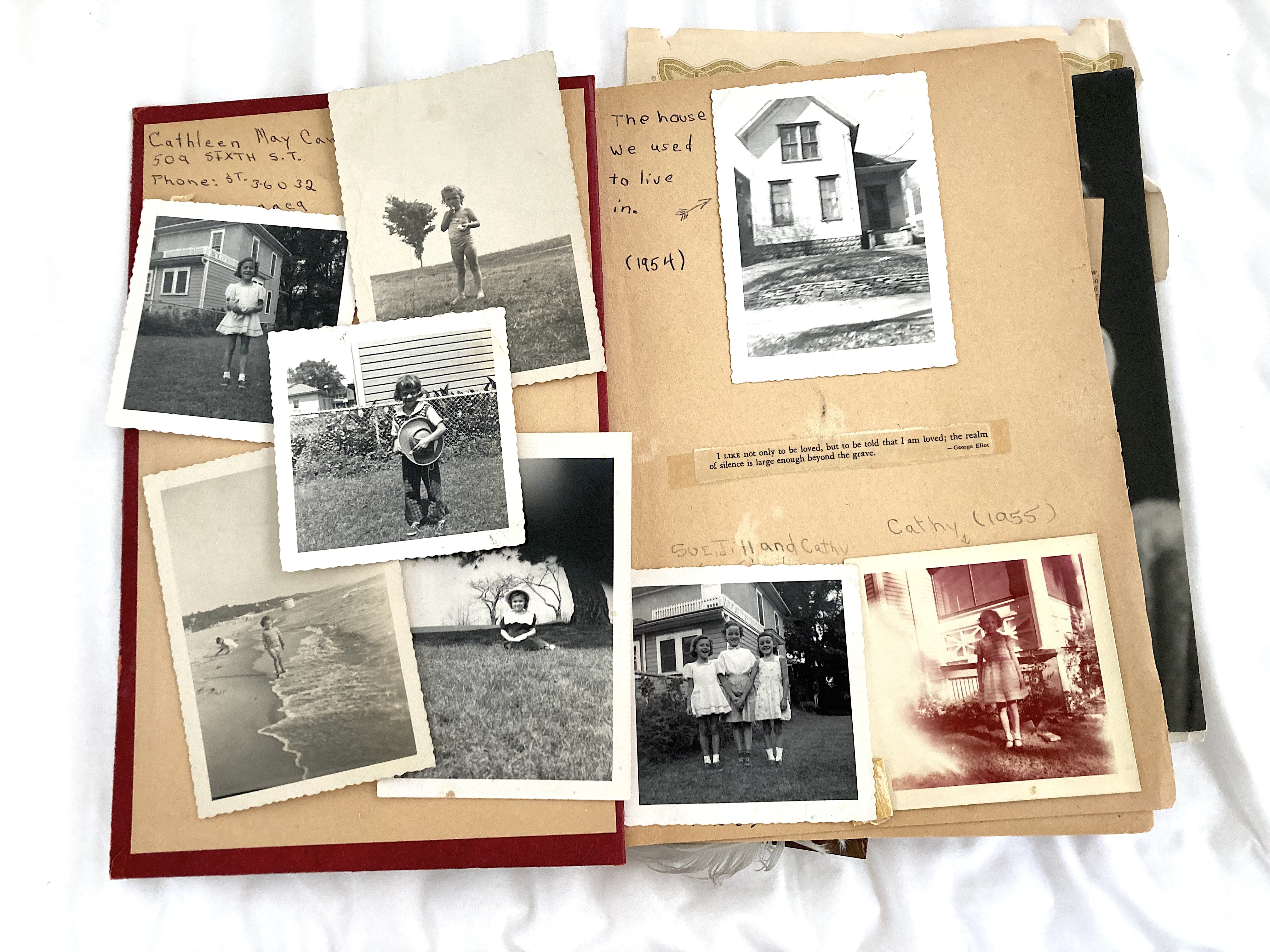
The first time she asked and answered was while putting together a Scrap Book she received for her birthday in 1957.
“It’ll be David.” She was matter-of-fact about it.
“Why?”
“Because I’m 9 today and he’s 9 years older, so as the start he’s closer to finishing.”
“You think you’ll watch us all go?”
“I haven’t figured that out yet,” she admitted, busily writing 1954 or 1955 under every photograph being pasted in the album.
“The house photo was from when we left there in 1953, and you weren’t even four years old in those other ones,” I corrected. “They should say 1951 and 1952.”
“I know. My book is about the before we aren’t ever again.”
She was referencing how my father had sold our home on the newly wrong side of town in favor of a house none of us wanted but him. So, she was right from the get-go. We weren’t.
The most cherished gift Cathy ever gave me was her Scrap Book.
In the center of the first page she had cellophane-taped a caption from a 1950’s local newspaper photograph:
“I like not only to be loved, but to be told that I am loved: the realm of silence is large enough beyond the grave.” — George Eliot
Almost as if she always knew.
Cathy left us in 2016.
The first of six.
#. #. #.
Marguerite Quantaine is an essayist and author.
“There’s never been a colored, a Jew, a Democrat, a Yankee, a queer, or a woman as Mayor of this town and there never will be!”
I glanced up from my notes to study the odd little man in his Oshkosh overalls, Penny’s plaid shirt, knee-high Frye boots and Tom Mix hat.
His cohorts called him Red. I don’t know if he was christened that, or nicknamed for the color of his neck — but it certainly didn’t stem from embarrassment by him, or any of the men at that district Republican Committee meeting rewarding him with whistles and a rousing applause as I sat alone in the far back corner of the small auditorium, recording the forum as a favor to the absent president of our local Republican Women’s Club.
And, all I could think was — what luck!
I wasn’t a committee member, so I couldn’t object without risking the security of self. But I was born in the small town that hosted the first Republican convention, under the oaks on July 6, 1854. An obscure granite rock with a bruised bronze plague once sat on a tiny patch of treeless grass, three short blocks from where I spent my most mis-informative years.
Back then, the rites of passage included adopting both the religion and political party affiliation of your parents. My parents were protestant and Republican. I’m neither, but during my juvenescence, I feigned being both.
The reality is, religion and politics have never been roadblocks for me. I tend to accept that we’re all going to believe what we need to believe in order to survive our slippery slope slide from here into hereafter. However, the pretense of politics alarms me, and it is the reason I always encourage women to run for public office.
I have.
It’s easier than you think, and more satisfying than you dare to imagine.
After filling out the simple forms with the Americanized spelling of my last name and paying a nominal filing fee, I learned you aren’t required to raise money, put up signs, hand out cards, take out ads, stand on street corners in inclement weather inhaling exhaust while waving to commuters — or even to serve if elected. All of which I did not do.
Instead, I entered the citywide race for Mayor because I could. And, because I learned the Mayor was in charge of the police force that allegedly created computer software profiling every resident according to age, gender, race, religion, political affiliation, marital status and coded lifestyle.
I ran because the Mayor had the power to veto city council legislation.
I ran because the personal voting records of all residents, their addresses, and phone numbers can be made available to campaign camps via their candidate.
I ran because it’s possible for local elected officials to access sensitive census information about their neighbors.
Ultimately, I ran to be be given equal time to speak at all candidate gatherings, lunches, forums, debates, and media interviews, followed by unlimited time to answer questions. Places where I could tell the people about the profiling, veto capability, records reality, and potential for both discrimination and profiteering to the detriment of the electorate should the information be misused by unscrupulous officials with a personal agenda to advance.
But chiefly, I ran because I was told by Party heads, “You cannot.”
“And yet,” I said, “I can.”
“You can’t run as a Republican.”
“Unless I’m registered as a Republican. Then I can.”
“It’s a nonpartisan race, so no one will know.”
“Unless it’s leaked.”
“You won’t have the backing of the Republican Party.”
Aye, and there’s the sub rosa.
Most of us like to think we’re supporting a candidate who shares our convictions and has our best interests in mind.
Go.
Run for office.
That’s when you learn it’s the Republican National Committee (RNC), the Democratic National Committee (DNC), and corporations funding them that dictates the conversation, feeds the media, and virtually runs this country in a Charlie-McCarthy-meets-Jerry-Mahoney-manner, where those connected contingents funnel all the money solicited from donors into the war chests of the candidates they’ve preselected to win.
I kid you not.
The nominees of both the RNC and DNC sign a Party platform pledge to toe the Party line, in order to receive the financial clout of the RNC, or DNC, because the chances of winning an election for those who don’t sign — even on a local level — are zip, zero, nada, nil.
And, get this: Those war chests can be used to funnel funds for phone banks to robocall citizens who have a voting history of going to the polls on odd, even, and off years. • They can funnel funds for surveys with contrived questions for the ostensible purpose of suggesting nonexistent improprieties practiced by the opposing party. • They can funnel funds for spamming newspapers with testimonial templates to praise one candidate, or deride the other, or push an agenda, or create confusion, or imply majority support, with each letter signed and sent by a party faithful — so it appears to the public as an original thought and legitimate concern rather than a parroted message. • They can funnel funds for business owners to be visited by party members offering recommendations on which candidates to support, along with a friendly suggestion of how valuable it is to have a customer base of political party members. • They can funnel funds for whisper campaigns, leaked to small presses, controlled by deep pocket party-pleasers, linked to online sites willing to post the disinformation.
And, get this: The strategies for beating your opponent are all recorded (or were when I ran) in an instruction manual detailing how to sway an election to a preferred candidate with news stories clouded by opinion. Where the media inserts the words ‘could, might, alleged, contend, claim, may, and if’ for ‘can, is, are, and will’ to report a ‘possible’ truth. Where newspaper corrections to falsehoods are buried in places no one reads. Where editorials aren’t required to be factual.
The old, paraphrased maxim still holds true: The most dangerous woman in the world is the one who can’t be bought.
That’s where running for political office serves as the American dream. Because running to lose by telling the unmitigated truth assures that your voice will be heard.
And isn’t that what we all want? To be heard?
When I ran for office, my words were so well heard, by the time election day rolled around they’d been stolen and used to further the campaigns of others running for even higher offices.
So, ladies, that’s how you make change happen. Not by sitting behind a safe screen, typing out rhetoric about what’s wrong with the country and who’s to blame. And, not by writing a check, convinced your donation will contribute to making this nation better and stronger.
Run for office.
Attend every avenue available for you to get up and speak. Recognize freedom of speech for the priceless gift it is. Say what’s in your heart. Ignore naysayers. Concentrate on connecting with real people. And experience the exhilaration that comes from putting your mouth where your mind is.
In the final analysis, the financial reports required to be filed by all candidates indicated the incumbent spent around one hundred and twenty-five dollars per ballot cast in favor of him to wage his campaign against me, while I didn’t spend a dime.
On election night I lost by less than 100 votes.
No, not once.
Twice.
Because the next time around I ran for school board, losing by lesser votes.
Whew!
#. # #.
Seriously, Mom, you didn’t know? By Marguerite Quantaine • Copyright © 2018
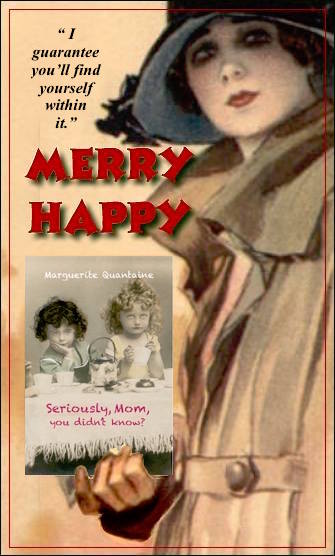
Always Look Inside to try a few chapters for FREE
on Amazon before considering the purchase of my books.
I can guarantee you’ll lose yourself,
only to find yourself
within.
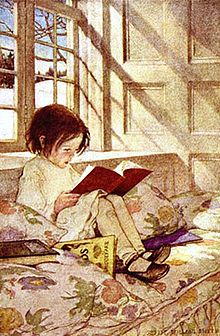
When I was five, we lived in a drafty, 1860’s, two story, white clapboard farmhouse insulated with wads of newsprint dating from the Civil War. It had a coal furnace to heat the water pumped into cast iron radiators for warming in winter and bathing year round, wafer thin linoleum covered floors, and a narrow pine brown painted staircase just inside the front door vestibule with nine stark steps heading straight up before snaking left for three more and leveling off to a thirteenth step at the top.
.
Facing directly ahead was the bedroom I shared with my two sisters. To the left, at the end of a hall papered in remnant rolls of Depression era patterns, was a bedroom for my three brothers. And at the right, flushed with the wall, was the entry to a closet containing a second, much smaller door leading to an exposed beams, no floorboards attic.
.
“Never, ever, under any circumstance open the door inside the closet at the top of the stairs,” my mom instructed us, “because, if you do, you’ll fall through the ceiling.” To be clear, she never added the words “and die” to the edict. So, I opened the door.
.
It wasn’t that I was a bad little girl, or even an overtly rebellious one. I simply had a ferocious curiosity which challenged every easy, accepted, purported, and fabricated reason given to blindly follow orders. And, anyhow, it was all Alice’s fault — she being Alice In Wonderland from the animated Disney film that Mom had taken us to see when it came to our town in 1951. Our subsequent incessant playing of the film’s score from a set of eight, six inch, 78 RPM Little Golden Records ensured I knew every word and melody, making it Alice who implanted the lyrics to Very Good Advice in my mind as a mantra, and Alice who told me to open the door and search for a lavender and white striped Cheshire cat in a garden of talking flowers.
.
But unlike Alice, I needed no key to unlock the door, nor mushroom to shrink myself for passing through, since even though the inner closet portal was half the size of a standard door, it wasn’t nearly as small as me.
.
… and more
———– TO CONTINUE READING ————
THE ABOVE ESSAY REPRESENTS AN EXCERPT FROM:
Seriously, Mom, you didn’t Know?
by Marguerite Quantaine © Copyright © 2019
NOW ON AMAZON & AVAILABLE IN BOOKSTORES NATIONWIDE
You are urged to LOOK INSIDE on Amazon for a try-before-you-buy FREE READ of the first 3 chapters.
Find Me On Amazon • Friend Me On Facebook • Follow Me On Twitter
# # #
Marguerite Quantaine is an essayist and author.
Never Ever Again © 9.29.17
.
I sincerely value your opinion and appreciate your sharing this with others.
Please select LEAVE A REPLY from below the headline
to tell me your thoughts on this post.
I’m all eyes and heart.
.
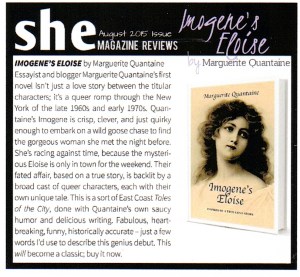
IMOGENE’S ELOISE : Inspired by a true story by Marguerite Quantaine
is available on Amazon in paperback and Kindle.
.

Charity
Some women choose other women for support, but many of our mother’s generation behaved like perpetual damsels in distress needing a man around to help them with the simplest things, catering to every male entering a room, putting their needs first and foremost, soliciting their opinions before making a decision, giving them the larger portions, the better chairs, the greater control, and endlessly feeding their egos.
Above all, they needed to be married to a man while encouraging every female within their inner circle to adopt their medieval mindset.
Elizabeth’s mom was like that, marrying three times after Liz’s dad suddenly died (although Liz ignores the nuptial that was annulled).
My mom was just as assiduous in promoting second-class citizenry, except for getting hitched again. Nevertheless, that didn’t stop her from relentlessly urging her daughters to marry, and dragging men into every conversation and situation.
Once, while leaving a Broadway show at the Palace theater in Manhattan, she grabbed the elbow of a man trying to maneuver the crowd outside the entrance and asked him what bus we should take to get uptown.
.
“How the hell would I know?” he steamed at her. “Do I look like a bus driver for God’s sake?”
“Well!” she huffed.
“That was Don Knotts, Mom.”
“Where?”
“The man you just asked for directions.”
“Andy Griffith’s Don Knotts?”
“Yes.”
“He certainly wasn’t very polite.”
.
…and more
———– TO CONTINUE READING ————
THE ABOVE ESSAY REPRESENTS AN EXCERPT FROM:
Seriously, Mom, you didn’t Know?
by Marguerite Quantaine © Copyright © 2019
NOW ON AMAZON & AVAILABLE IN BOOKSTORES NATIONWIDE
You are urged to LOOK INSIDE on Amazon for a try-before-you-buy FREE READ of the first 3 chapters.
Find Me On Amazon • Friend Me On Facebook • Follow Me On Twitter
# # #
.
by Marguerite Quantaine, Copyright © 8.31.17
.
Marguerite Quantaine is an essayist and author.
Her novel, Imogene’s Eloise : Inspired by a true-love story
is available AMAZON, in paperback , and on Kindle.
.
Please select LEAVE A REPLY at the top of the page
to tell me your thoughts on this essay.
I’m all eyes and heart.
Thank you!
.
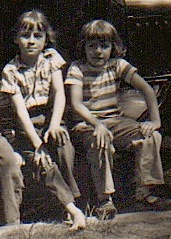
The last three words my sweetheart and I speak to each other before hanging up the phone are “I love you.” We say the same in public places whenever going our separate ways, when exiting the house either alone or together, and before falling asleep each night. Sometimes I even say them when leaving her to tidy up the kitchen as I head upstairs to write. The words are always heartfelt. Never flung. Never forgotten.
.
I learned to say “I love you” from my mom who thought we should say it to our siblings whenever one of us walked out the door. We didn’t, although the words were a given between me and her, and similarly exchanged between my kid sister, Kate, and I.
.
Otherwise, I’m reluctant to express them.
.
I don’t recall my father ever saying “I love you” to me or my sisters except in a tickle poem he mostly used to torture Kate. He was a misogynist when it came to his daughters and a misogamist due to our unwanted births. For certain, I neither felt, nor uttered the sentiment to him.
.
It’s no secret that my father wanted six sons, having cast himself as too virile to spawn females, so I can’t speak for my brother’s relationships with him. Besides, the three boys were all older, during a period when practicing sexism thrived. They’ve remained distant for most my life. Not as antagonists, mind you. There’s no ill will. Indeed, our communications are always engaging. But we’re more like friends with certain secrets kept than family with skeletal closets closed.
.
In fact, I doubt they know, immediately after returning home from a forced 48 hour stay in the mental ward of Foote Memorial Hospital (tethered to a bed by brown leather straps with gray metal buckles), I tried to kill my father with a salad fork. Where I found a salad fork is baffling, since salads were never part of any meal plan when we were young, save for the Waldorf variety when Michigan Macintoshes were plentiful. Admittedly, patricide by salad fork seems tame by today’s road rage comparison, but in 1962 small town, midwest America, even the hint of such news would knock the kid washing his duck in the kitchen sink off the front page (or at least lower it below the fold).
… and more
# # #
THE ABOVE ESSAY REPRESENTS AN EXCERPT FROM:
Seriously, Mom, you didn’t Know?
by Marguerite Quantaine © Copyright © 2019
NOW ON AMAZON & AVAILABLE IN BOOKSTORES NATIONWIDE
You are urged to LOOK INSIDE for a try-before-you-buy FREE READ of the first 3 chapters on Amazon.
by Marguerite Quantaine Copyright @ 2017
.
CLICK ON & THE BOOK OPENS TO A FREE 3+ CHAPTER PREVIEW
If it skips ahead, just tap the left arrow.
.
.
I’m deeply interested in
what you’re thinking and feeling.
PLEASE SELECT REPLY
to add your comments here.
.
.
Marguerite Quantaine is an essayist and author.
Her novel,
IMOGENE’S ELOISE: Inspired by a true story
is available on Amazon in paperback and Kindle.
Choose LOOK INSIDE for a free read prior to considering purchase.
.

My mom hated to have her hair touched. It prompted her to enroll in beauty school for the sole purpose of learning the best way to style and care for her own thick, black, naturally curly locks. I still have the leather bound 1930s textbook from her beauty school days that she abandoned upon deciding to coil her hair and pin it atop her head like a crown of glory. It was very attractive, even enviable, and she never fashioned her hair differently from then on until the day she died, decades later, three weeks shy of age ninety-three
I suppose that’s why it came as no surprise in the summer of 1958 — when I was still eleven with shades of natural auburn and blonde streaking throughout my wispy thin, straight as straw, mostly mousey brown hair — that mom suggested I choose one of the three colors and dye it.
I chose auburn; Clairol’s Sparkling Sherry to be exact. It perfectly matched my auburn undertones and duplicated the color my older sister, Sue, chose to dye her hair a year earlier. It cost 85¢ for a glass bottle of the dye and another 25¢ for a bottle of peroxide. You mixed them before applying, waited 45 minutes, and then washed the residue out with Halo shampoo before rinsing with diluted Heinz red cider vinegar.
“The dye coats each strand. It doubles the thickness of your hair,” Mom promised.
“Do I still use vinegar?” I questioned, even though I already knew it untangled wet hair and kept it glossy.
“It prevents the color from looking unnatural.”
That fall I began the seventh grade as a redhead, just as Sue had the year before me. Whenever anyone asked us why our brother, Michael, had black hair we’d confess, “He dyes his.”
.
…and more
# # #
The balance of this essay can be found in
Seriously, Mom, you didn’t know?
CLICK ON & THE BOOK ABOVE, OPENS TO A FREE 3+ CHAPTER PREVIEW
If it skips ahead, just tap the left arrow.
Marguerite Quantaine © 2016
.
Please feel free to SHARE THIS on Facebook and Twitter,
and be certain to tell me your impressions by selecting REPLY.
I’m all eyes and heart.
.
Copyright by Marguerite Quantaine © 2016
.
.
Marguerite Quantaine is an essayist and author.
Her novel, Imogene’s Eloise : Inspired by a true-love story
is available on AMAZON, in paperback and Kindle.
Please choose LOOK INSIDE for a FREE
read of several chapters.
.
FranCat
While watching a rerun of The Antiques Roadshow broadcasting from Tulsa, I got a message from my friend, Frances Walker Phipps. It was sent to me from infinity and beyond, but arrived just fine. No dropped call.
.
Frances was a reporter for several Connecticut newspapers, the antiques columnist for The New York Times Connecticut Weekly, the author of several definitive reference books on American antiques and colonial kitchens, and the founder of The Connecticut Antiques Show (1973), touted as one of the five most prestigious such events in the nation. Renown as a barracuda among a tribe of elite dealers who vied for the chance to earn a space in her much envied function, Frances determined what could, or could not be displayed on the show floor; what was, or was not an authentic antique. Her strict vetting of merchandise on preview night was surreptitiously referred to as the Phipps ‘reign of terror’.
.
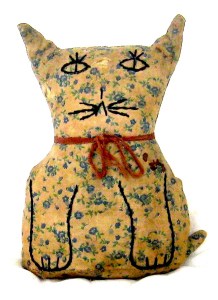
The Tulsa Roadshow featured a woman who presented a folk art doll for discovery. I don’t own a folk art doll, but I do have a folk art cat that Frances gave me from her private collection of antiques dating from the 17th and 18th century, like most of the chairs, tables, cupboards, beds, books and decorations in her Haddam, Connecticut home. Hand stitched from swatches of forget-me-not floral broadcloth and twisted black yarn to form it’s Queen Anne stylized eyes, nose, mouth, whiskers, and outline of front legs with four toes, the coveted cat is in remarkable condition, even with the two small tears near it’s right eye, and drops of dried blood near it’s heart. I suspect the cat is older and rarer than the Roadshow doll appraised at fifteen hundred dollars.
The assessment made me smile — not for the price it garnered, but for what Frances said in my head:
“Bull.”
.
Frances was once an attractive woman with thick, wavy hair, a bright smile, a great mind, and a fervor for the preservation of Colonial Americana.
But by the time we first met she’d matured into an unpretentious, stout woman with a big bust, a fierce wit, an untamed tongue, rumpled clothes, a bad wig pulled down like a wool cap onto her head, and a folded over Kleenex stuffed behind the right lens of her black horn-rimmed classes to hide a socket ravaged by a malignant tumor.
We were introduced by her ex, Midgie Donaldson, on opening night of the Connecticut Antiques Show in 1975 when I was the editor of a fledgling magazine, The Antiquarian, and she was the highly respected authority wielding power and influence over dealers selling to the rich and famous.
“So, you came here thinking I’d teach you all about antiques. Is that it?” she proposed.
“No-o,” I counterpointed. “But I heard you have an eye for it.”
We bonded instantaneously.
.
… and more
# # #
THE ABOVE EXCERPT IS FROM:
Seriously, Mom, you didn’t know?
by Marguerite Quantaine © Copyright 2019
Paperback & Kindle
Available on Amazon and in bookstores nationwide.
CLICK ON & THIS BOOK OPENS TO A FREE 3+ CHAPTER PREVIEW (If it skips ahead, just tap the left arrow.)
.
Marguerite Quantaine is an essayist and author.
Her novel, Imogene’s Eloise : Inspired by a true-love story
is available on AMAZON, in paperback and Kindle. Please choose LOOK INSIDE
For a free read of several chapters before buying.
.
 M A G P I E à la modus operandi