Tag Archives: Love

THE TELLTALE HEART

Publicly, Thomas Jefferson believed in the principles of freedom. But privately, he grappled over whether the worst white man was still better than the best black man.

Ultimately, Jefferson’s failure to champion equality left his own illegitimate child enslaved, opening the wound which has since defined – not the competency of his mind – but the capacity of his heart.

We are once again at a crossroads governing the use of fine print to qualify equality.

But this time, the Jeffersonian paradox challenges whether we, as a nation, believe the worst heterosexual is still better than the best homosexual.

Because all the worst heterosexuals can marry anywhere in America. But even the best homosexuals cannot.

As the high court strips away all righteous rhetoric and political posturing, it’s possible they’ll recognize a raw reality, i.e., even when heterosexuals commit the most heinous crimes (murder, rape, child molestation, spousal abuse, terrorism, treason, and crimes against humanity), their known deviant behaviors are ignored by American marriage laws.

However, even when homosexuals are model citizens, their single, aberrant activity is prepossessed.

The court must then question whether this speaks to the heart of who we truly are, regardless of what we profess ourselves to be.

On the one hand, we insist the purpose of marriage is a belief in the sanctity of family.

On the other, we ignore the fact that millions of felons sitting in high security prisons are predominately heterosexuals possessing marginal moral character at best.

Yet each has a right to marry.

In some sit the suspects and convicts held for complicity in the 9/11 and Boston marathon attacks. And even they have the legal right to marry in every state.

But Lily Tomlin doesn’t.

Charles Manson, Sirhan Sirhan, David Berkowitz, the Menendez brothers, Theodore Kaczynski, James Eagan Holmes and Dzhokhar Tsarnaev can.

But Ellen DeGeneres can’t.

The former, loathsome, dictator Saddam Hussein, terrorist leader Osama Bin Ladin, and even Chancellor Adolf Hitler could have.

But Kate Smith, an American icon of our anthem, God Bless America, could not.

If the court entertains the position that “sin” is the foundation on which law is defined, will it validate the proponent “hate the sin, not the sinner” premise?

Can it then ignore evidence that it isn’t “sin” being shunned, profiled, attacked, ridiculed, denied equal rights and murdered?

Only American citizens are.

Will the court ask why there are no marches planned, political wars being waged, or state constitutional amendments being drafted against the seven deadly sins? Will it demand to know why it’s only a singular, Bible referenced, declared abomination being targeted? And, if it’s determined the sin/sinner assertion is an inflamed edict, could it set precedence for other inflamed edicts as just-cause to alter constitutional law?

Should the court recognize the Ten Commandments governing the worship of other Gods, building graven images, working on the Sabbath, blasphemy, dishonoring parents, murder, adultery, stealing, coveting, and bearing false witness as written-in-stone, will it be compelled to admit that being gay is not?

…and more
THE ABOVE EXCERPT IS FROM:

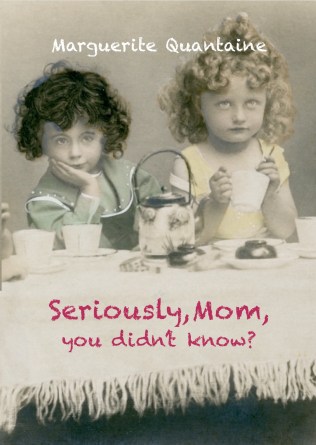
Seriously, Mom, you didn’t know?
by Marguerite Quantaine © Copyright 2019

THIS LINK OPENS TO A FREE 3+ CHAPTER PREVIEW
(If it skips ahead, just tap the left arrow.)


#    #    #

This freshly edited, updated essay was first published in 2004 to benefit L.I. Pride. Copyright by Marguerite Quantaine © 2004 & 2013.

What’s your stand the issue of equality? How will the Supreme Court decision on DOMA affect you, personally?

Please share your thoughts, here, by selecting REPLY.

I’m all eyes and heart.

–  –  –  –

PAST, IMPERFECT, INTENSE

Me@7

My father taught me things. They weren’t always the right things, or the best things, but he taught me all things, well.

One winterkill night while driving home alone together, he taught me his truth about lying. I was 7, then.

My mom was working as a confidante and caregiver at a private cottage for forlorn cancer patients. Her curtailed quietus watch of 11 to 7 promised us six kids we wouldn’t awaken without her.

“I’ll always be here to tuck you in and be back before breakfast,” she assured. It was enough for them, but not for me.

“I’m riding along,” I reckoned.

“Maybe in the morning, if you’re up.”

“Then, too,” I determined, set as cement.

She gently pressed the nub of my nose, lighting me up in her eyes. “You’re my little lion,” she said. “You give me courage.”

My parents weren’t friends then, if ever. Lovers once, no doubt. He as dashing as she was beauteous. Each with ebony locks. His, glossed waves. Hers, coiled curls. His jaw, chiseled. Her cheeks, rubicund. His eyes, bruin black, set tangent to an arrowed nose. Hers, bairn blue, gracing a Gaelic bob. Both seeped sheen and sensuality. The two as one? An envied ornament hung among plebeians.

But that was all ephemeral, lost long before the happenstance of me.

Oh sure, photos find him masterful in monochrome. Meritorious. Certainly indubitable. And it can be quibbled he didn’t become deriding and distant until after he began colorizing her with kids.

Regardless, I never espied demonstrative signs of affection between them. Neither gentility, nor joy. She endured his disrespect as wifeliness, while zesting motherhood. He husbanded acrimoniously, fatherly only to his firstborn.

And so it was, of all the trips we made together with mom in tow or mind, I remember that worst one best.

“DammitallMaggie,” he one-worded her. “It’s nearly 11. Move it!”

“Don’t get your dander up,” she growled back while winking my way. The dishes, nearly done. The laundry, almost folded. The house in chaos but cleaned down the middle and after-a-fashion. My siblings accounted for, kissed and sleeping. “I’m ready when you are.”

It was the most they’d spoken to one another all day, remaining silent in their seats until he skidded to the stop where we left her – just in time.

I remember watching her maneuver the hard packed snow and patches of ice while edging her way up the embankment toward that halfway house of enduring desperation. And how my father peeled off, leaving her without help, headlights, or sentiment for her safety.

During the drive home I kept my face glued toward the passenger window, contented to imagine mom in the morning, and it being my nose pressed against the frosted pane, greeting her return to us.

My father spoke to the back of my head when he said, “People lie to you because they don’t respect you enough to tell the truth.”

I remained removed; brown eyes searching boundless skies.

“They’ll cloak their words in omission, feigning innocence, thinking you’re too stupid to recognize the lie.” He paused, letting it etch.

I counted stars.

“That’s what they’re saying though. That they think you’re stupid.”

I yearned for Jupiter and Mars.

“The more deliberate and petty the lie, the less value they make of you.”

I found Venus.

“You know you’re utterly worthless when someone lies to you for sport.” He reiterated and enunciated, “Utterly.”

…and more
THE ABOVE EXCERPT IS FROM:

Seriously, Mom, you didn’t know?
by Marguerite Quantaine © Copyright 2019

THIS LINK OPENS TO A FREE 3+ CHAPTER PREVIEW
(If it skips ahead, just tap the left arrow.)


# # #

This freshly edited, updated essay by Marguerite Quantaine first appeared in the St. Petersburg Times five years ago. (Copyright by Quantaine © 2008 • 2013)

IMPERFECT CHILDHOOD? Lessons learned? Please select REPLY to share your thoughts.

I’m all eyes and heart.

A CAUSE FOR CELEBRATION

B1

The preliminary police report rendered me dead upon impact.

A drunk driving a Marathon cab fitted with an extended, reinforced steel bumper had broadsided us. He was clocking up to 70 in a 30-mph zone when he ran a red light and collided with the VW Bug I was easing into a parking spot as Liz sat next to me in the suicide seat.

The impact was ferocious. While peripheral vision allowed me a glimpse of my killer, there was no other warning. No screeching of brakes. No screaming of pedestrians. No sense of impending doom. Just a mild feeling of astonishment before whispering, “Oh my God, I’m dead.” That’s what I said.

Our car was ripped apart (lengthwise) from hood to trunk, welding the sheared pieces to the front end of the taxi. Twenty feet away, our flung wreckage had come to a halt at the entrance of a branch bank. I hung down twisted and broken through the remains, my face hovering just above the pavement, my auburn curls resembling a red rag mop.

Most gay couples are drawn and quartered by such tragedy. They’re impeded by laws awarding jurisdiction to distant family members. They’re intimidated by protocol and prodded by propriety. Their feelings and wishes are summarily dismissed as irrelevant. Barred from the ambulance. Excluded from intensive care. Denied decision-making.

“She’s my sister,” Liz lied emphatically. It instantly ended any question of her authority.

The first time she lied was to the officers who barricaded the wreckage, then tried to restrain her from reaching back for me. They’d dragged her clear, insisting I was beyond help.

How she broke loose, and what transpired is a wonder.

I must have responded to the energy of her touch. I must have been warmed to the blending of her tears in my stone-cold eyes. I must have sensed the silent incantations of her heart imploring mine to hold the course of ‘us’ as one, against all obstacles and odds.

“Hey, babe!” I breathed.

Her second lie was to the ambulance attendants. The third, to emergency room doctors. The fourth, to nurses. And then to technicians, aides, and investigators. She didn’t hesitate to claim me as her sister, knowing involuntary deceit had long been coerced from gays in lieu of being banished and public humiliation.

Lies were once our only conceivable lifeline.

Fortunately, I was a corporate executive for a large conglomerate. It gave me special insurance privileges that provided her with unlimited hospital access. She stayed in my room. She partook in every detail of my care and was privy to all my medical information. My doctors consulted her. My nurses kept her updated.

Nevertheless, when it came to certain courses of action, not everything suggested was automatically allowed.

It’s because (even now) most lesbians mistrust the medical profession. We cringe at the prospect of contact with male doctors. We shy to probes pertaining to our personal lives and intimate behavior. And, even though many older women entered conventional relationships in an effort to hide their true sexual identities, there are vast numbers of lesbians who have never engaged in intimacy with a man. Women who know being gay goes far beyond an aversion to heterosexual sex; that the differences in our genetic codes include a wiring that circuits a deep-seated aversion and basic incompatibility with all dominant aspects of the opposite gender.

It’s as if (equivalent to the distinction found between Asian and African elephants trumpeting in the night) science will someday discover that we, too, are a similar — but different — species.

So it came as no surprise to Liz when I refused to be catheterized, even though catheterization was necessary to save me. Regardless of the brutal total body trauma I suffered, this perfectly natural anomaly had triggered my sense of dignity, demanding decorum. Only the empathy and courage of a surgical nurse named Christine could clear the emergency room of male doctors and provide me with the symbiosis I needed to survive.

…and more
THE ABOVE EXCERPT IS FROM:
Seriously, Mom, you didn’t know?
by Marguerite Quantaine © Copyright 2019

THIS LINK OPENS TO A FREE 3+ CHAPTER PREVIEW
(If it skips ahead, just tap the left arrow.)


#   #   #   #

This freshly updated essay by Marguerite Quantaine first appeared in the third person in The St. Petersburg Times (2008) and Venus Magazine in the first person (2010).  Copyright by M. Quantaine © 2008 / 2010 / 2013.

Please share your thoughts here by selecting REPLY.

I’m all eyes and heart.

AS GOOD AS GAY GETS

One determined little 5 year old.

One determined little 5 year old.

By Marguerite Quantaine

Someday my novel will be optioned by a mainstream publisher, rate stellar reviews, be adapted to film oozing romance through eloquent innuendo, and receive the acclaim of people who’ll prattle over my sudden success.

But they’ll be instantaneously mistaken (about my success being sudden) because I’ve worked hard all of my (remembered) life.

I began my callings at age 5, collecting castoff bottles for return to wooden crates at the corner, single pump gas station with its big red cooler of cola immersed in ice water and a grease monkey teetering on a beat-up stool next to it paying me a penny a find.

At 7 (being small and scrawny for my age), my brother dressed me as a waif to knock on the doors of upper class condos, selling occupants Christmas cards they probably never sent, but gave me my dollar a box because I looked so pitifully poor, like a melancholic mutt on the street corner wagging its tail, twanging their untuned heartstrings.

At 8, I shoveled snow with a spade in the winter (that’s right, a spade), pushed mowers in the summer, and raked leaves in the fall, underpaid with nickels by anyone willing to exploit me.

At 10, I delivered newspapers on my brothers routes, rising before daybreak to cut the hairy nylon twine from big bundles left on neighborhood street corners, rolling and folding each paper to perfection, burnishing and stuffing them into a canvas bag dragged along behind me, pitching the papers towards porches, then hurrying home in time to don a dress and walk 3 miles to school (that’s right, 3 miles).

At 14, I claimed I was 15 to get a genuine job (4 to 9 weekdays, 9 to 9 on Saturday) selling records at a store that only hired boys for the 30 years before I sailed through the door.

“Why should I hire you?” asked the owner, a doddering, Dickens-like character whose bifocals were as thick as block glass and modish flattop belied his desire to appear younger. “Boys bring in girls who like records.”

“Boys flirt with girls that giggle and irk paying customers,” I countered. “Boys arrive late, leave early, take cigarette breaks, and call in sick from phone booths at football games.” I let that set a second before adding, “I have red hair. I’m cute enough to attract boys who’ll talk to me about girls. I’ll sell them records for those girls. Whenever they win one over — and they will (I winked) with my expert advice — they’ll be back to buy more.”

“Expert advice?”

“I have a two-sport-varsity older brother and one bombshell of a sister. I’ve heard all their gameplay. Try me. You’ll see.”

He did, teaching me purchasing, cataloging, product display, inventory control, advertising, and promotion. I was the first girl hired there, then the first girl hired as a research editor for a local trade magazine, then the first girl hired as a proof-runner for the daily newspaper before I finally fled my hometown for the big city beat.

I arrived in New York with $126.00 lining my red-rubber boots, no job prospects, no place to live, and no plans beyond attending The American Academy of Dramatic Arts where I’d earned an entry after winning the regional finals of a television talent search in which I’d been entered (unknowingly).

Being awed and alone in Manhattan was thrilling. I saw all directions as arrows angled upwards.

All I had going for me was attitude on my first day (faking-it) as a graphic artist.

All I had going for me was attitude on my first day (faking-it) as a graphic artist.

Insisting “Oh sure, I can do that” gained me the gig of being the first female hired as a graphic artist at the United Parcel Service (even though I’d never seen a t-square, held a razor knife, or knew how to crop a photograph). After several months of (intense) covert tutelage by the fellow at an adjacent art board, I snagged a (enviable) job at a Fifth Avenue ad agency where I was promoted to management (the first female Purchasing Agent) in 5 months time. Within 3 years I parlayed that into a corporate office fashion industry position where I excelled until being struck by a drunk-driven taxicab. The driver flew the coop and the cab company declared bankruptcy (as did the insurance company holding the cab’s policy), catapulting my career back to ground zero (accompanied by chronic disabilities).

and more
THE ABOVE EXCERPT IS FROM:

Seriously, Mom, you didn’t know?
by Marguerite Quantaine © Copyright 2019

THIS LINK OPENS TO A FREE 3+ CHAPTER PREVIEW
(If it skips ahead, just tap the left arrow.)

# # #

Is (gay) life good for you? Are you (still) dreaming (big)?
Select REPLY and tell me.

I’m all eyes (and heart).

THE LOOK OF LOVE

Front Cover 4 FBI’m a ninth generation American homosexual.

Either that or there’s an amazing number of spinsters and bachelors in my ancestry. I count the potential for several in every generation on both sides of the family over the past 350 years.

Perhaps that’s why the stigma attached to being single wasn’t an issue in my upbringing. My father’s sister never married. And even though the topic of why wasn’t openly broached, my maternal grandmother divorced after her second daughter was born. She spent the balance of her life as single, in the close company of women.

I suppose you could misconstrue this as proof that it’s possible to be raised gay, or that I was. But you’d be wrong. I wasn’t raised to be sexual at all. Like so many of my generation, the subject of sex was taboo in our home. And even though I grew up with two sisters and three brothers, we never shared conversations of an intimate nature until we were all well into our forties. Even then, the conversations between us were strictly casual.

My father was as distant by choice as my mother was demonstrative by nature. It was she who showed us how happiness flows from doing good. We learned to be courteous, courageous, curious and kind. We were exposed to music, literature, art and theater. We were trained to respect language through oratory and debate. And while exploring the works of William Shakespeare, my mother implored us to hold dear the line, “To thine own self be true.”


So don’t think it took some long struggle with my sexual identity before I spoke the words “I’m gay” to my mom. Nor was it her fear of hurting my feelings that kept an exchange from happening before she reached 89.

It’s simply — believe it or not — most lesbians I’ve encountered don’t consciously categorize themselves as being such, per se. I know I don’t. I never have.

True, I avoided dating while in high school and remained chaste until halfway through my 23rd year. By then the family phone fêtes had my younger sister convinced I was a recluse while my older sister swore I must be on something (or should be).

Hence, when I called home from New York City that glorious March day in 1970 to tell Mom I’d be bringing a friend back for a visit, she was delighted. She didn’t question what the relationship entailed or which gender it involved. All that mattered was I’d finally connected with someone.

No one has questioned it since. Elizabeth remains the only love of my life. For the past 49 years, we’ve lived under the same roof sharing the same bank account, abiding by the same ethics, collaborating in the same businesses, supporting the same candidates, and demonstrating the same respect and affections for an array of animals.


We’ve never been purposely apart in all those years. Never taken separate vacations, or wanted to. Never appeared at gatherings alone. Never accepted an invitation unless the other’s name was included on the envelope. Never sent a birthday card, letter, or holiday greeting without our joint salutation.

We aren’t provocative or particularly political. There’s no role-playing, recognition-dressing, or exhibitionism. And, even though our choice to remain reserved is based on a nothing-to-hide-nothing-to-share ideology, you can’t exactly classify us as closeted.

The fact is, a rare few have ever asked us, “Are you gay?” Instead, we’ve been treated like any other two people who graciously appear as an extension of the other. But then, at age 89, Mom finally brought it up.

“Why now?” I asked her during our daily long-distance chat.

“I watched a biography on television last night about two men who had this great devotion for each other,” she recounted. “And I marveled at how wonderful it must be to know that kind of love. It made me think of you and Liz.”

My eyes welled.

“But they led such tragic lives in many ways,” she continued. “I hope no one’s ever been mean to you like that.”

I recognized a question masked in those words.

•••

Mom and I were always close. She was a role model for the independent spirit I became, a mentor of uncommon good sense, and a show of courage in the face of futility. But there are things I’d never confided — mostly because they all occurred to me in retrospect, long after I’d missed the meaning of the stone thrown.

I recall I’d just turned 15, fresh from being voted the wittiest girl in my class and slated to become editor of the school paper, a forensics champion, pantomimist, and finally, most photographed face in my senior yearbook. Plus, some considered me cute to boot.

Yet I was never a team player. I rarely attended school events. I avoided pep rallies. I didn’t spend after-hours with classmates. I resisted temptation and defied intimidation, refusing to follow the crowd. And I simply didn’t date.

It’s not that I lacked opportunity. Indeed, my primary pals were male. But I was careful to keep boys at bay, preferring platonic relationships restricted to school hours or clustered occasions. Because my mind wasn’t functioning in the immediate present back then. It was clouded with illusions of running off to New York’s West Village to live as a Bohemian poetess and consumer underachiever.

One afternoon while stopping to pick up books for history class, I noticed a word scrawled sideways down my hallway locker, with letters the six-foot length and one-foot width of the door: Q-U-E-E-R.

———– TO CONTINUE READING ————
THE ABOVE ESSAY REPRESENTS AN EXCERPT FROM:
Seriously, Mom, you didn’t Know?
by Marguerite Quantaine © Copyright © 2019

You can finish this story by clicking this link to open the book to Chapter One for a FREE read of it, plus 2 more chapters:


#    #    #

Marguerite Quantaine is an essayist, novelist, and animal rights activist.

This refreshed essay copyrighted by Marguerite Quantaine © 2002 first appeared in The St. Petersburg Times and will serve as the introduction essay in her latest book,

Seriously, Mom, you didn’t know? by Marguerite Quantaine

NOW ON AMAZON & AVAILABLE IN BOOKSTORES NATIONWIDE

Available in paperback and on Kindle, May 13, 2019.